
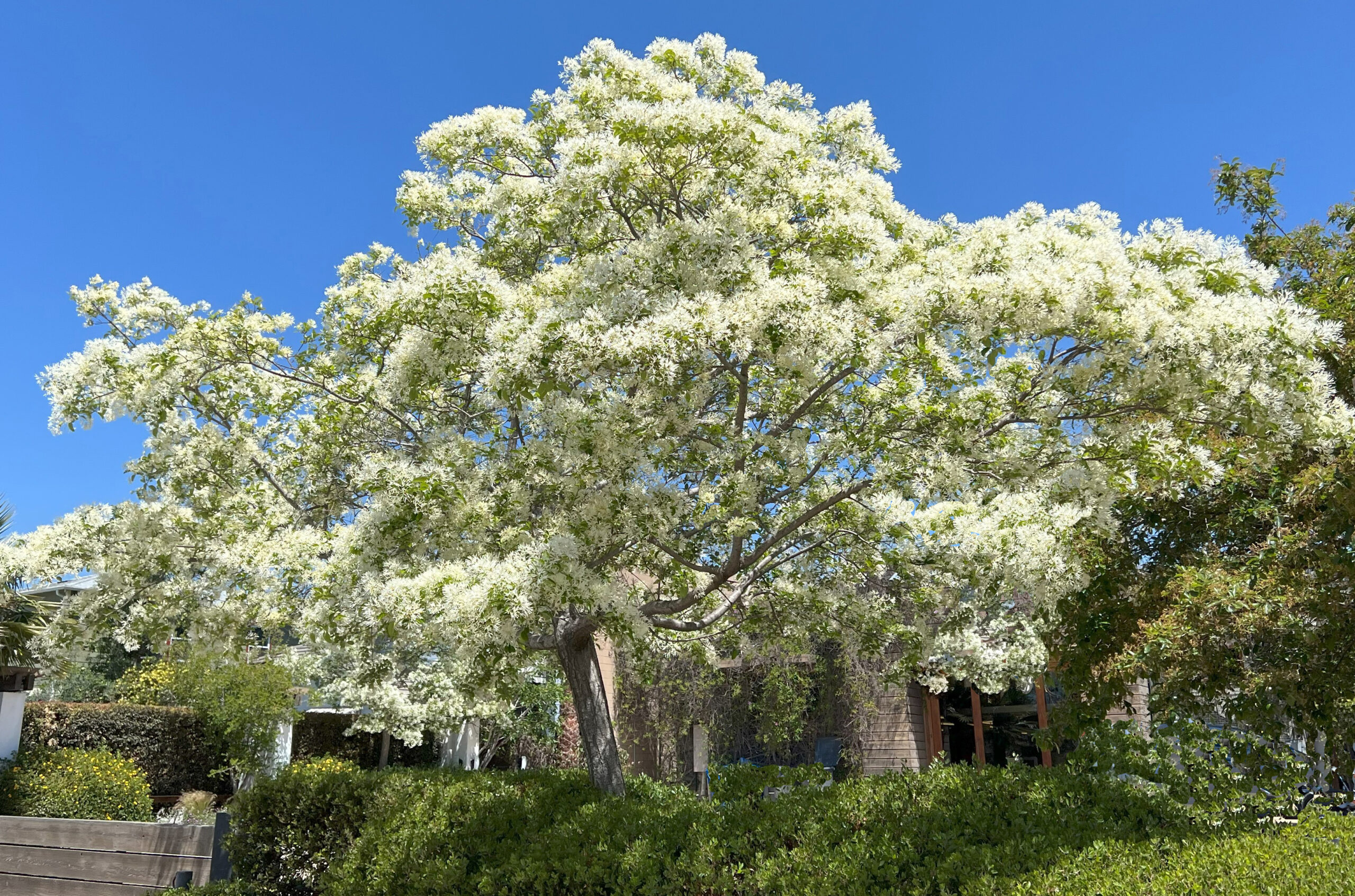
 The Chinese Fringe Tree is a small tree with a big floral display – in spring, it is quite covered with glorious clusters of flowers bearing delicate, fringe-like, petals. Although relatively few of these trees have been planted in Santa Barbara, these few attract well-deserved attention.
This lovely tree is particularly suitable for gardens in our community, because of its small size and its low-maintenance requirements. It grows slowly to form a broad spreading crown with a height and spread of 15- to 20-feet. When young, it will often have a rather sprawling and irregular growth habit; with age, it will become fuller and more symmetrical.
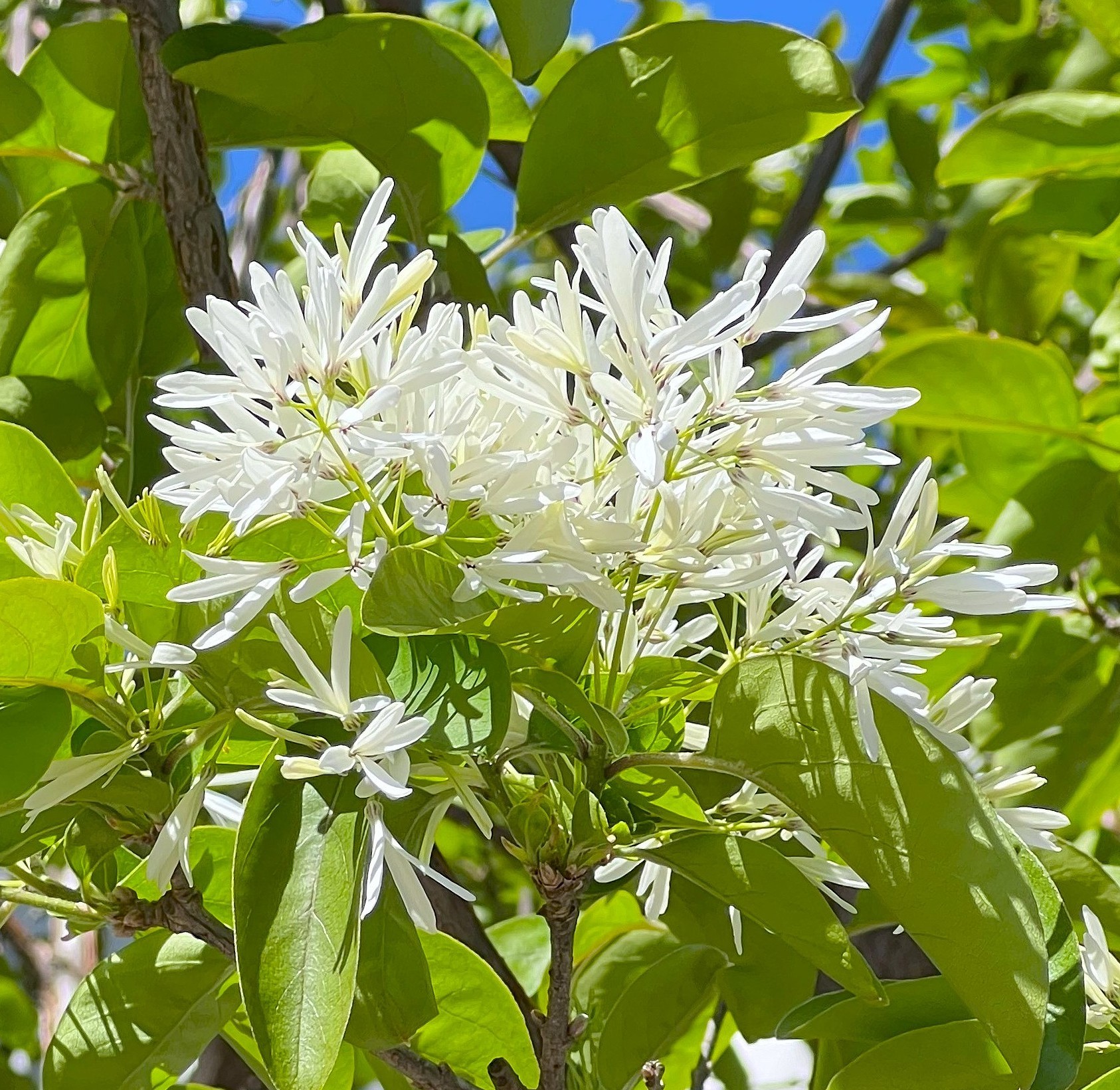
After a brief period in winter when it is deciduous (bare of leaves), the canopy in spring is covered with a profusion of 1-inch-long white flowers that appear in clusters up to 4-inches-long at the end of its branches. This tree is “dioecious”, which means male flowers and female flowers occur on separate trees. The male flowers are larger than the female flowers.
 After pollination, female flowers will develop fruits that are blue to black in color, ½-inch-long, and drupes (a single seed covered with a thin layer of flesh and skin). These will ripen in late summer into fall. Birds love the fruit – devouring it as a nutritious source of food – and subsequently drop the seeds, together with a generous dollop of guano fertilizer.
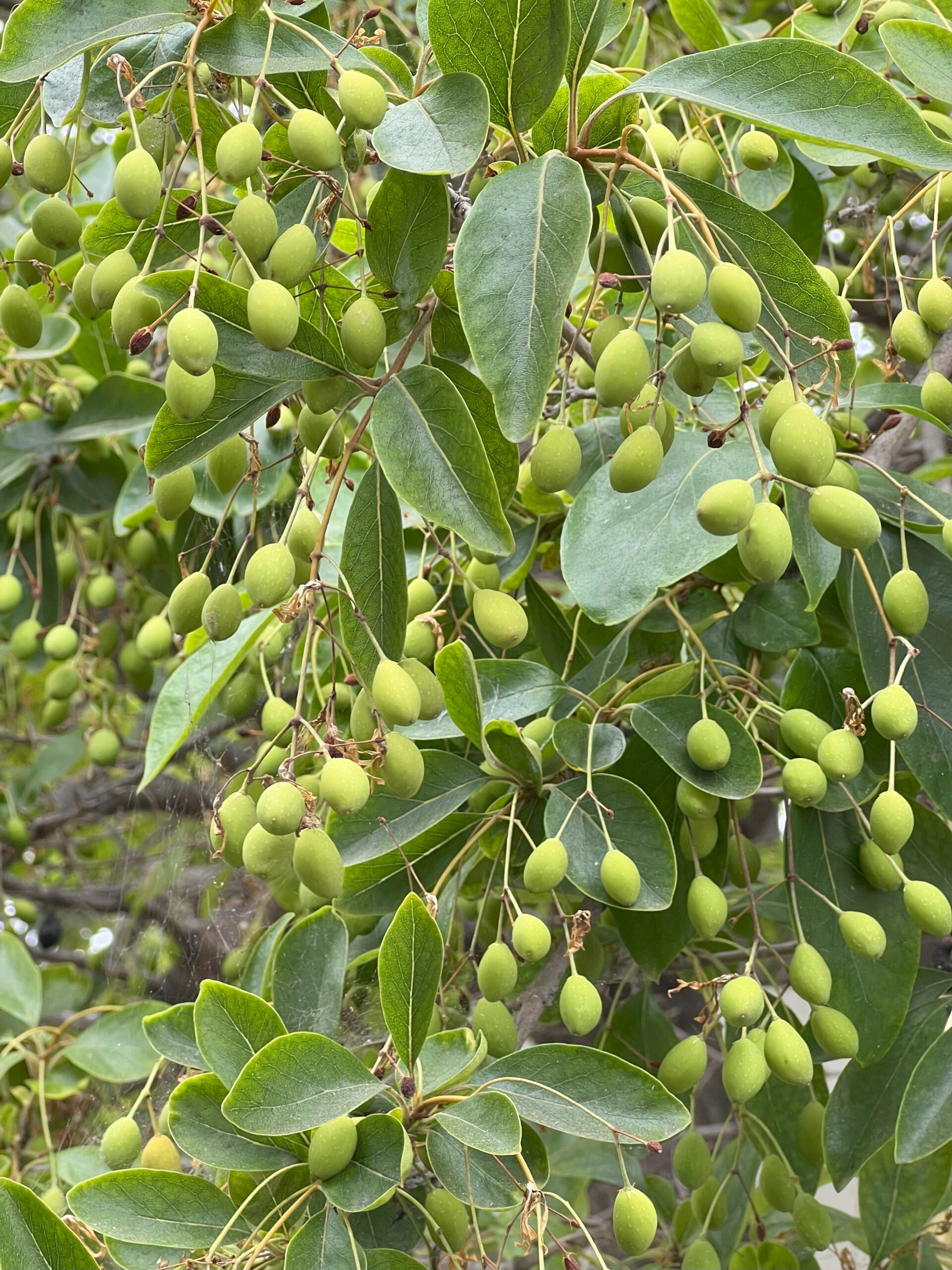 After flowering, glossy leaves develop. The oblong ovate leaves (5- inches-long and 2½-inches- wide) appear in a pattern of opposing pairs on the twigs. The simple leaves have a leathery feel, smooth margins, and a small notch at the tips. On top, the leaves are bright green; underneath, they are light green with both midribs and larger veins rather hairy. In the fall, the leaves turn an attractive yellow and then drop.
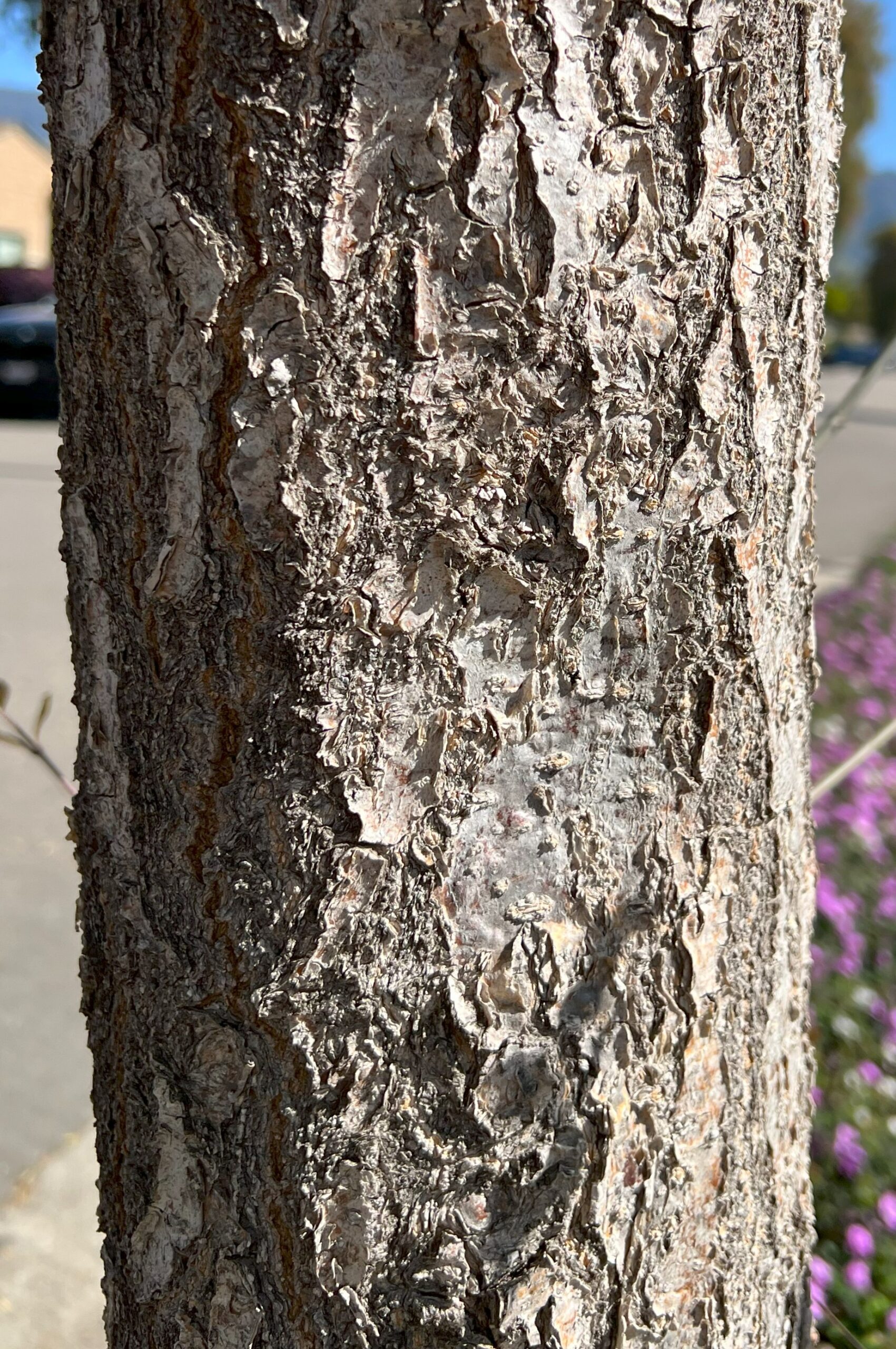
The bark is light gray in color and will flake off to reveal an even lighter bark beneath; this is an attractive ornamental feature, especially in winter when the tree is bare.
 It is native to moist mixed forests, below 6,000 feet, in central China, Korea, Japan, and Taiwan. There, it commonly grows as a large multiple-stemmed shrub. Even though its native habitats receive ample rainfall – a good deal more than in our community – it seems to be fairly drought-tolerant when grown here.
Chinese Fringe Tree is in the Oleaceae (olive) plant family. Its botanical name is Chionanthus retusus. Its genus name, Chionanthus, is derived from the combination of the Greek words, chion, meaning “snow”, and anthus, meaning “flower”. Its specific epithet, retusus, is Latin, meaning “terminating in a rounded apex with a notch”, referring to its notched leaf tips.
Chinese Fringe Tree is easy to grow. It flowers best in locations with full sun – but the foliage looks more luxurious in partial shade. It can grow in most soil types – but does best when planted in a mildly acidic, well-drained, deep sandy loam. While it is reasonably drought-tolerant, it will appreciate irrigation in the dry season or in extended droughts. It is surprisingly cold-tolerant and can be grown in the coldest of our local microclimates. Happily, it is not known to be affected by any serious insect or disease pest. It requires minimal pruning. It can be trained to become a multiple-trunked or a single-trunked tree.
The Chinese Fringe Tree makes a perfect addition to garden of all sizes. In small formal or informal gardens, it is a delight as a single specimen tree focal point, particularly when set against a hedge of dark foliage. In larger gardens, it looks fabulous when planted together in numbers as a grove. It works especially well in Japanese gardens.
Oddly enough, only a few specimens of Chinese Fringe Tree are yet available for public viewing in our area: as street trees, in the 2100 block of Chino Street (at Eucalyptus Ave); as ornamentals, in parking lots at 600 Block Olive Street and at 3761 State Street; on the campus of UC Santa Barbara (just one); and, several in the Japanese Garden of Ganna Walska Lotusland. Given how beautiful and hardy this lovely tree is, we certainly should plant many more in our community.
Tree-of-the-Month articles are sponsored by Santa Barbara Beautiful, whose many missions include the increase of public awareness and appreciation of Santa Barbara’s many outstanding trees and, in a long-time partnership with the City Parks & Recreation Department, the funding and planting of trees along the City’s streets.
Those who wish to honor a special someone can do so with an attractive commemorative marker that will be installed at the base of an existing street tree in the City of Santa Barbara. Because Santa Barbara Beautiful has participated in the planting to date of over 14,000 street trees, there are plenty of trees from which to choose! Application forms are available on the Santa Barbara Beautiful website, www.sbbeautiful.org. This website also contains an archive of all previously published Tree-of-the-Month articles, including photos.
Article and Photos by David Gress