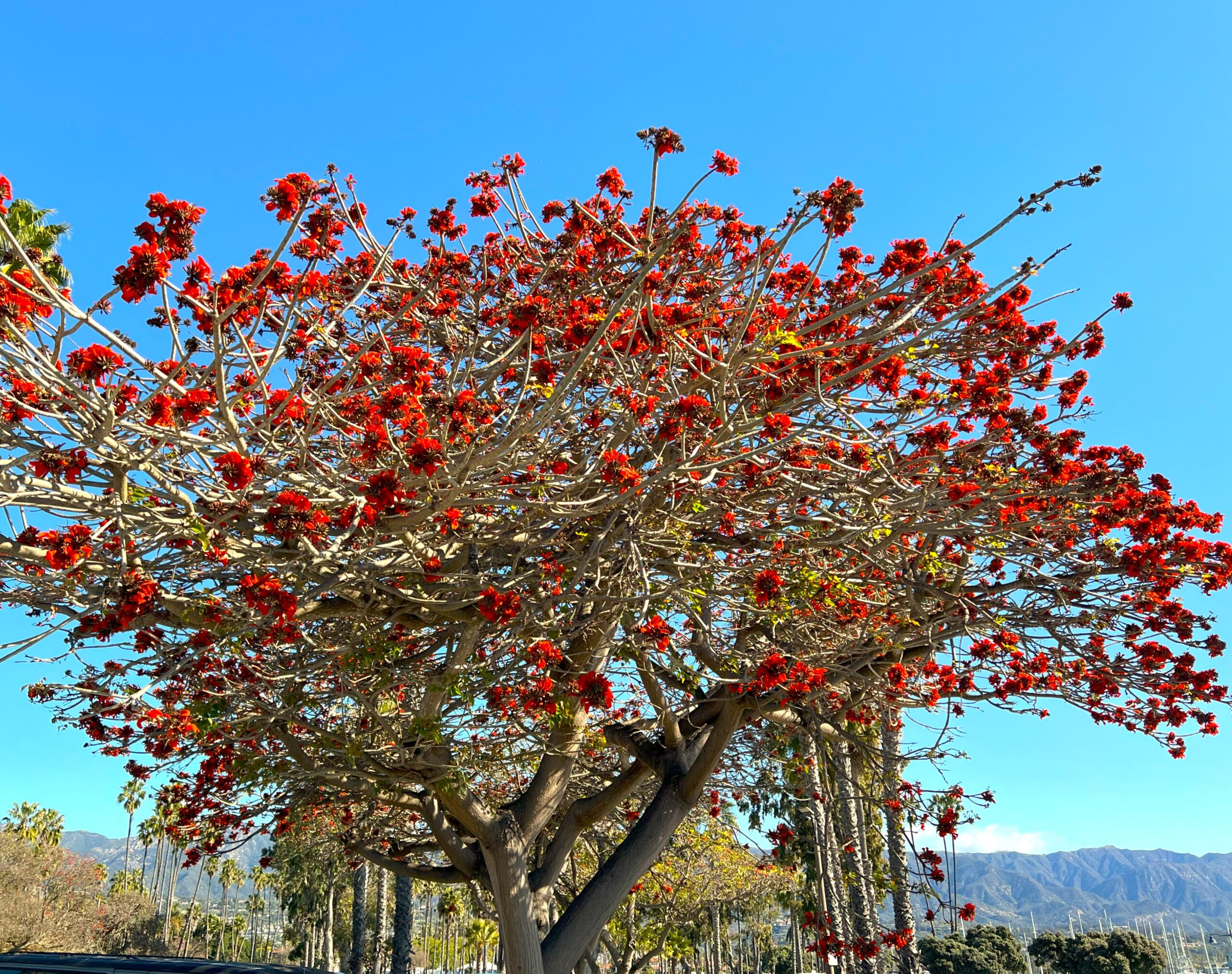
 The African Coral Tree is one of the most spectacular of flowering trees. It is the largest of more than a dozen coral tree species that grow in our area and has the most magnificent floral display. Its large clusters of coral-colored flowers are remarkable standouts in the landscape, particularly as they appear on nearly bare branches during a short deciduous period.
While being native to the coastal regions of southeast Africa, from the Cape province to Natal, the African Coral Tree is perfectly suited to our community, because both areas have similar Mediterranean climates.
The African Coral Tree was introduced to Santa Barbara in 1908 by the pioneering horticulturist and nurseryman, Dr. Francesco Franceschi. Since then, it has been frequently planted in coastal areas throughout Southern California. Its popularity can be attributed to its relatively fast growth, gorgeous flowers, and dense canopy of leaves. Its beauty has garnered such admiration that it has been designated the official tree of Los Angeles.
This medium- to large-sized tree can reach 25- to 40-feet tall with an equal spread. Most are almost evergreen but may be briefly deciduous in winter.
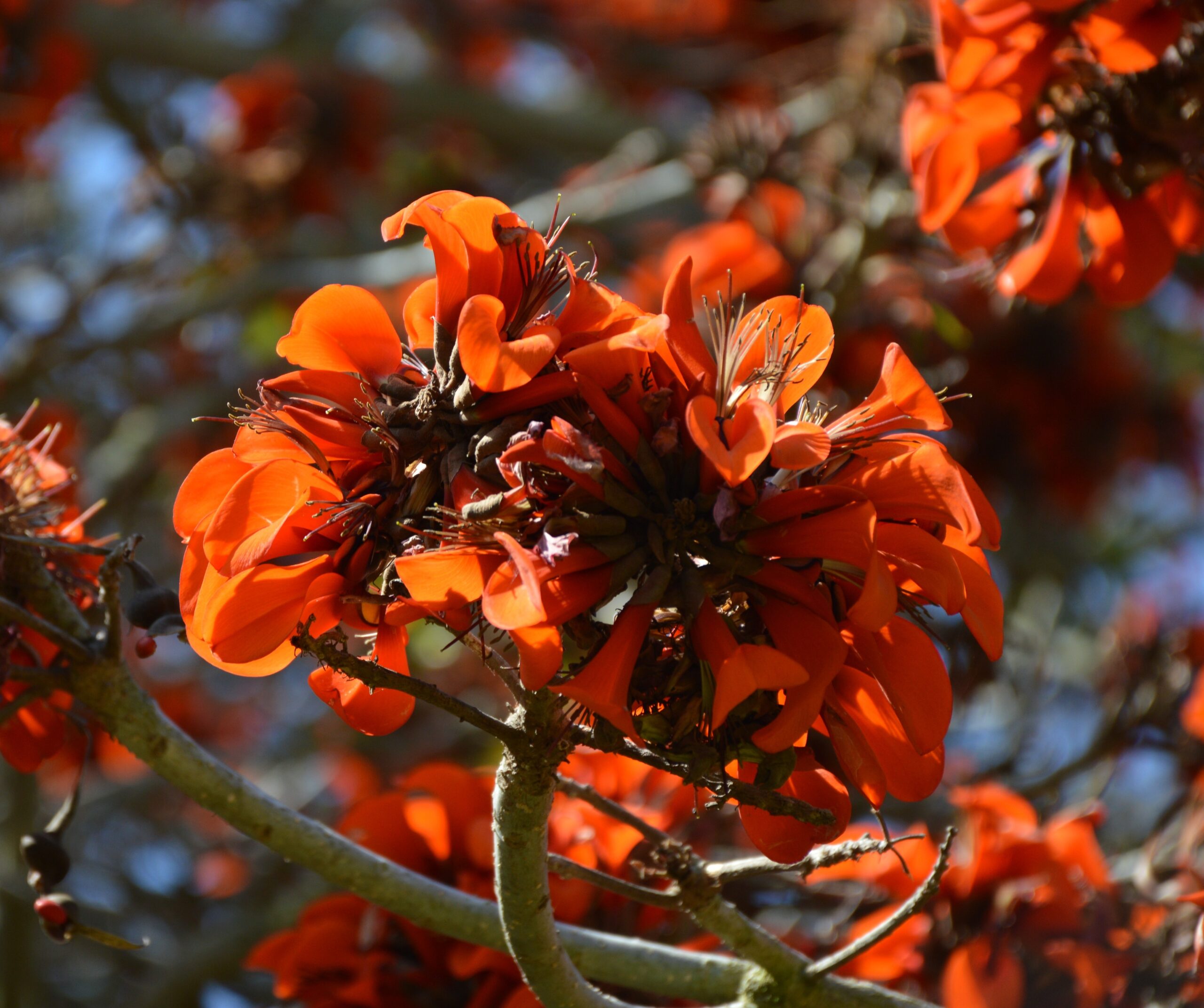
Flowering occurs from late winter to early spring, when dark orange to scarlet blooms appear in massive clusters (8 inches across) at or near the end of its branches – with up to 80 flowers per cluster! Each exotic-looking flower has a primary petal (called a banner) that arches back to expose the reproductive parts. Abundant flower nectar and vibrant colors attract insect and bird pollinators.
 After the flowers are pollinated, their leathery brown seed pods (6- to 8-inches long) develop and are deeply constricted around the seeds. As pods age, they split open to reveal up to 5 bright-red oval seeds. Beware: despite their attractive appearance, the seeds are highly toxic and poisonous to eat.
When flowering is over, new dark green compound leaves emerge on 8-inch-long leaf stems, called petioles, each bearing three diamond-shaped (deltoid) leaflets (2- to 5-inches in length and width).
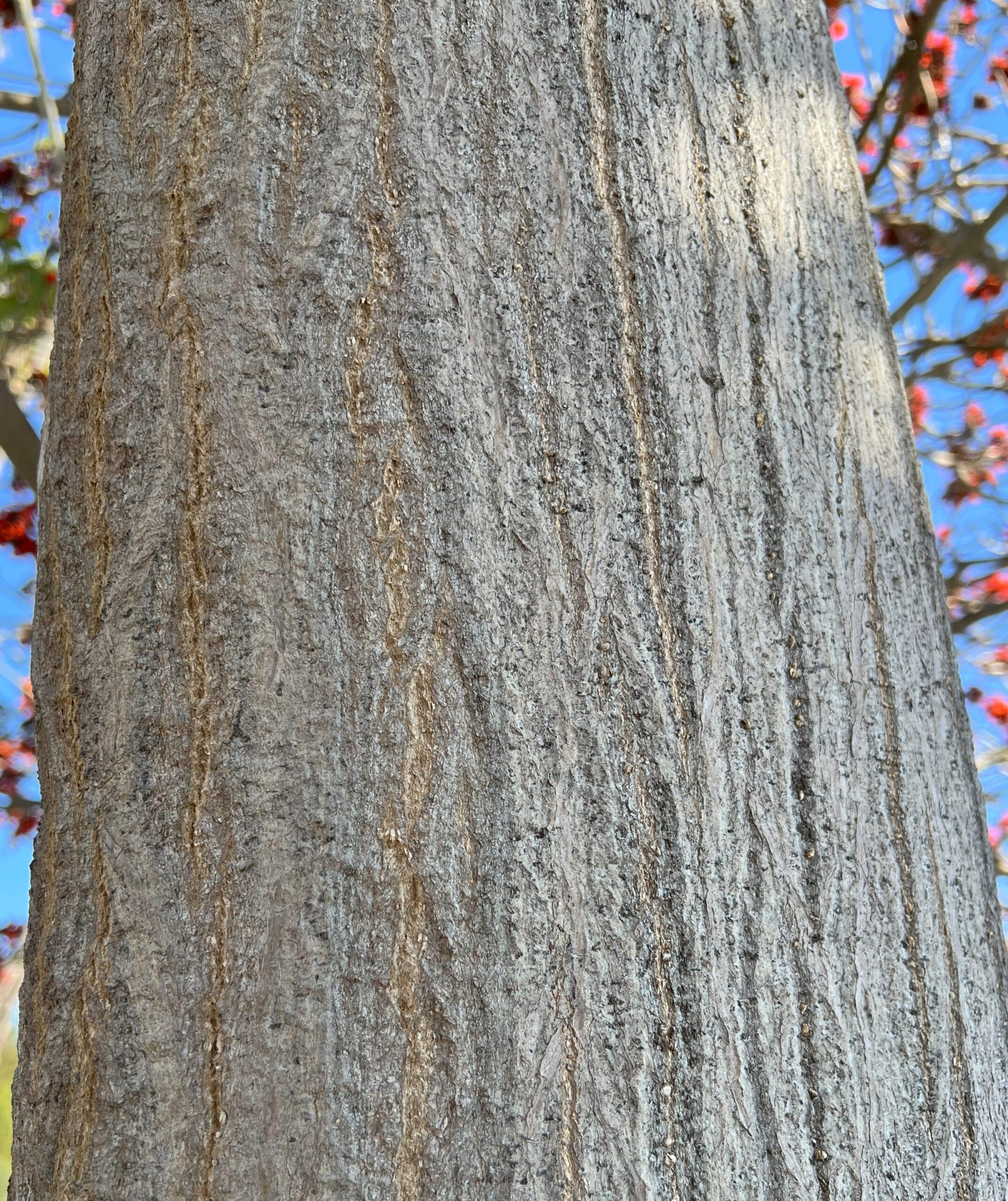
The bark has hues of yellow green; in time, it will turn gray. On young trees, the trunks and limbs can have longitudinal fissures; with maturity, these will become smooth. On young growth, short prickly thorns are pointedly evident; with age, these will often disappear. Unfortunately, its wood is soft and brittle, which can result in rather dramatic breakage of heavy limbs and even trunks. Consequently, regular – and significant – pruning is required.
 The botanical name for the African Coral Tree is Erythrina afra. The genus name, Erythrina, is from the Greek word “’erythros”, meaning “red”, and refers to the color of its flowers and seeds. Its recently changed specific epithet, “afra”, denotes its origins in South Africa. It goes by other common names, including “Cape Coral Tree”, and “Coastal Coral Tree”.
Also frequently grown in Santa Barbara is its close relative, Erythrina coralloides, the Naked Coral Tree, which looks somewhat similar and is often confused with E. afra. A simple way to tell the difference is from their leaf habits. The Naked Coral Tree, as its name suggests, is fully deciduous during winter, whereas the African Coral Tree is mostly evergreen year-round. All species of coral trees are in the plant family Fabaceae, which includes legumes, peas, and beans.
The African Coral Tree is easy to grow. To propagate trees from seed, prepare the seeds by soaking them in warm water for a couple of days. The seeds that sink will be viable and should germinate within 2 weeks. Trees can also be propagated from stem cuttings, which will produce plants that are genetically identical.
Fortunately for us, the African Coral Tree is relatively drought tolerant. Of course, it will do better with infrequent deep watering during dry seasons – but mature trees can generally survive on just our normal rainfall. However, it is not frost-tolerant and can be damaged if the temperature drops below 28 degrees F. It does well in most soil types found in Santa Barbara. When selecting a location to plant this tree, take into consideration its large size at maturity – give it plenty of room to accommodate its impressive branching structure and sprawling surface roots. It does prefer a spot with full sun.
With its broad spreading canopy and colorful flowers, the African Coral Tree makes a lovely ornamental shade tree with a bold appearance for large private gardens, as well as for public parks and open spaces.
Mature specimens of the African Coral Tree can be seen in the center of Alice Keck Park Memorial Garden, on the Fiqueroa Street side of the County Courthouse, at the Santa Barbara Harbor (mixed with Naked Coral Trees), On the north and south sides of Highway 101 at Garden Street, in the 3900 Block of State Street, at the corner of Cota Street and Chiquita Road, and at the corner of Barker Pass and Eucalyptus Hill Road. A large number also stand at various locations on the campus of UC Santa Barbara.
Tree-of-the-Month articles are sponsored by Santa Barbara Beautiful, whose many missions include the increase of public awareness and appreciation of Santa Barbara’s many outstanding trees and, in a long-time partnership with the City Parks & Recreation Department, the funding and planting of trees along the City’s streets.
Those who wish to honor a special someone can do so with an attractive commemorative marker that will be installed at the base of an existing street tree in the City of Santa Barbara. Because Santa Barbara Beautiful has participated in the planting to date of over 14,000 street trees, there are plenty of trees from which to choose! Application forms are available on the Santa Barbara Beautiful website, www.sbbeautiful.org.
Article and Photos by David Gress