
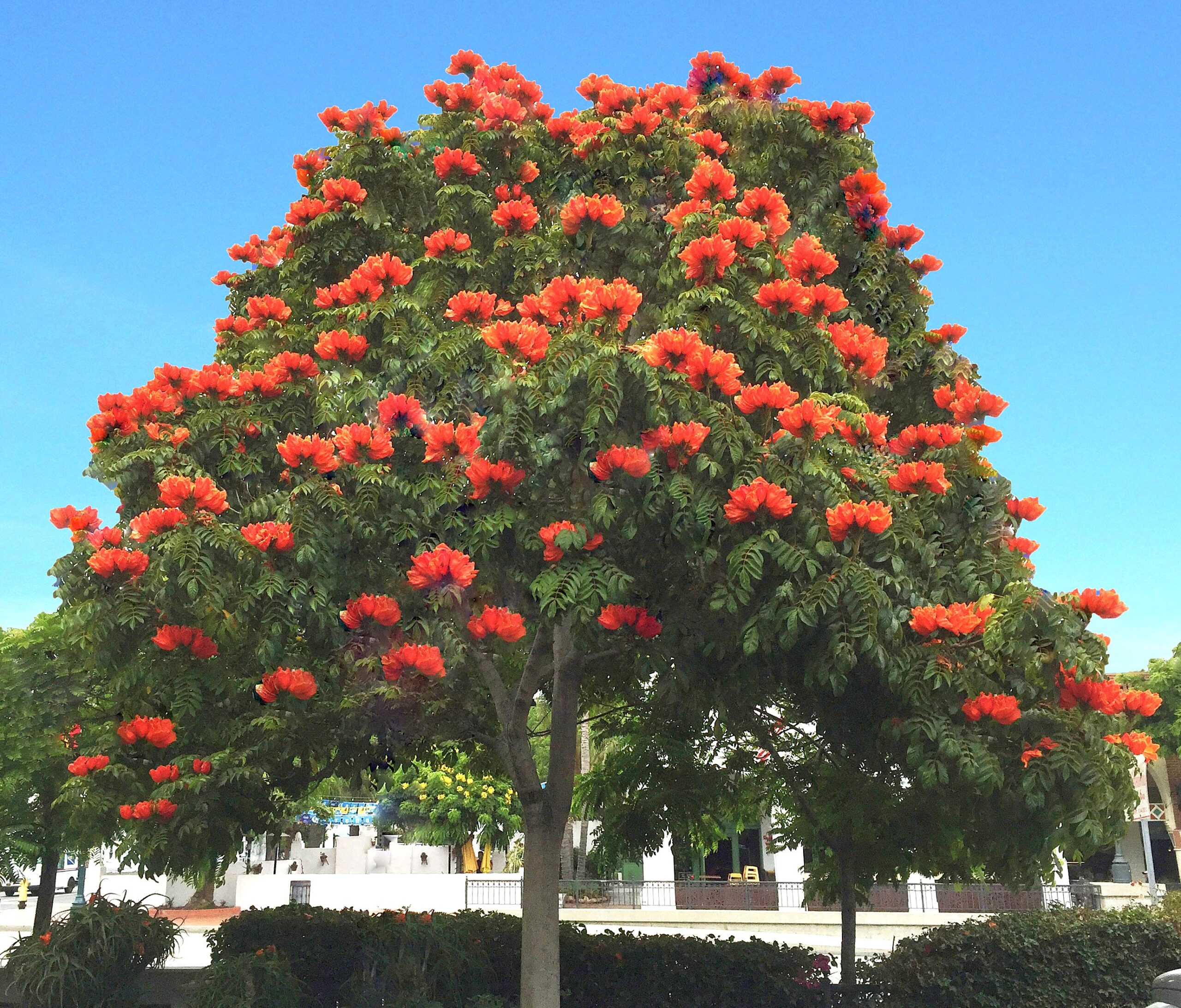
Considered by many horticulturists to be the most beautiful flowering tree in the world, African Tulip Trees are now putting on their best show of glorious blooms in Santa Barbara.
In 1908, one of our local pioneering nurserymen, Dr. Francesco Franceschi, first introduced them to California. Surprisingly, they remained fairly rare in our community – until the late 1970s, when our City Arborists began to plant them in larger numbers as street trees.
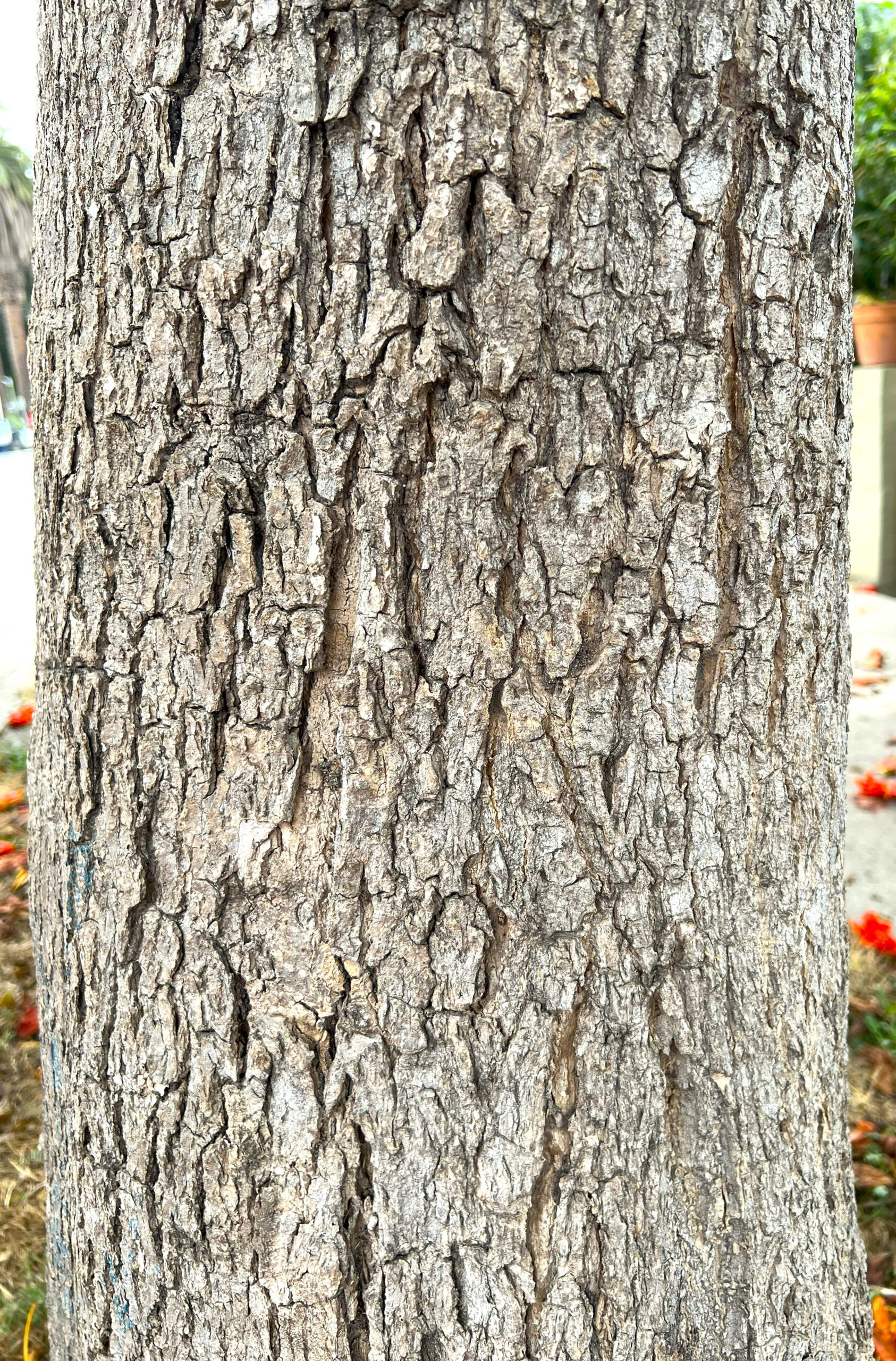
In our climate, African Tulip Tree grows to become a small- to medium-sized tree (25- to 35-feet high) with a rounded crown (15- to 25-feet wide). It is covered with lush, glossy, dark green, pinnately compound (feather-like) leaves that are rather large (15-inches long). The leaves are comprised of 9 to 19 ovate leaflets (2- to 4-inches long and 1- to 2-inches wide). The bark is beige-brown when young, gray-brown and lightly fissured with age, which forms a distinctive contrast against the dark foliage.
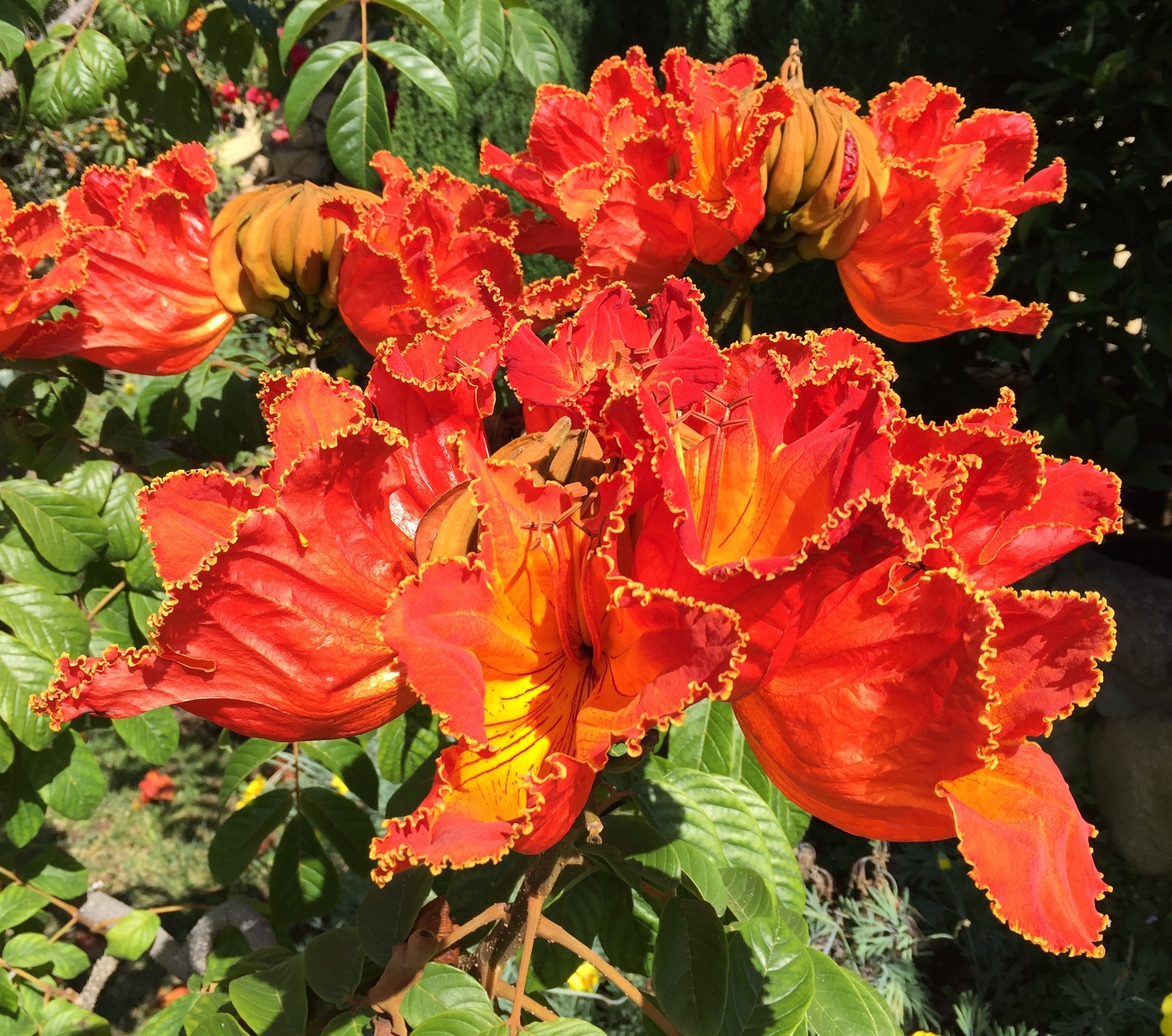
 Of course, its most striking feature is its brilliant orange flowers that create a dazzling display over its canopy. From August to October, stunning flowers form in clusters at the ends of branches. Each flower is trumpet- or tulip-shaped, large (4-inches long and 2- to 3-inches wide), and often fringed in yellow – rendering them almost fluorescent in the sunlight. The flowers are “perfect”, containing both male and female flowering parts. A variety bearing only yellow flowers can occur from seedling populations, but grafting is required to ensure this color.
 Pollinated flowers develop into narrow oblong seed capsules (7- to 8-inches long) that turn a dark blackish brown when ripe and then split open to release up to 500 winged seeds!
As its name implies, African Tulip Tree is native to Africa, from Senegal to Ethiopia, appearing in dry-tropical forests. They are reputed to be invasive in tropical regions – though not in our warmer Mediterranean climate.
Its tropical origin makes it susceptible to damage from frost or temperatures below 28 degrees Fahrenheit. In our area and during (rarely experienced) colder winters, it can suffer light freezing back to its small branches, with a rapid recovery in the next growing season. In colder areas with prolonged freezing temperatures, more severe damage can occur.
In its native range, it has been used in traditional medicine for a wide variety of conditions including malaria, diabetes, and gastrointestinal conditions. Elsewhere, its primary use is as an ornamental tree.
Other common names for African Tulip Tree are “Flame Tree”, “Pickari”, and “Nandi Flame Tree”. It is in the Bignoniaceae (trumpet flower) plant family – and, thus, is related to the Jacaranda tree (Jacaranda mimosifolia) that also flowers here so spectacularly. Its botanical name is Spathodea campanulata. The genus name, Spathodea, comes from a combination of the Greek words “spathe” (meaning “boat-shaped”) and “oides” (meaning “resembling”), referring to the shape of the flowers. The specific epithet, campanulata, comes from the Latin word, “campanula” (meaning “little bell”), also referring to the flower shape.
It grows best in deep, well-drained soil, but it does seem to survive in a wide variety of soil conditions. When first planted out in our community, it will require supplemental irrigation; when established, it will do quite well on our limited natural rainfall. It is easy to grow since, fortunately, it has no serious insect or disease problems. Its limbs are a bit brittle, so minor pruning may be necessary to keep it safe from high winds. Those planted in the open are usually deciduous in the winter; those placed in protected areas can be evergreen.
African Tulip Tree is an eye-catching focal point in our gardens – and provides a remarkable display on our streets. Certainly, it deserves to be planted more regularly in our community, wherever the landscape needs beautification!
There are many places to observe these magnificent trees in town: on the 100-300 blocks of North Voluntario Street; on the 100 block of South Voluntario Street; on the first two blocks of South Alisos Street; on El Prado Road; on the first block of East Los Olivos Street; the first block of West Los Olivos Street; on Arguello Road, on Lee Drive; and, in the City parking lot at State Street and Gutierrez Street. There are examples of the rarer, yellow-flowered variety at 16 West Los Olivos Street and on El Prado Road. Several lovely specimens are on the UCSB campus. It would be well worth your effort to go seek out and view these trees now, while they are in their full floral splendor.
Tree-of-the-Month articles are sponsored by Santa Barbara Beautiful, whose many missions include the increase of public awareness and appreciation of Santa Barbara’s many outstanding trees and, in a long-time partnership with the City Parks & Recreation Department, the funding and planting of trees along the City’s streets.
Those who wish to honor a special someone can do so with an attractive commemorative marker that will be installed at the base of an existing street tree in the City of Santa Barbara. Because Santa Barbara Beautiful has participated in the planting to date of over 14,000 street trees, there are plenty of trees from which to choose! Application forms are available on the Santa Barbara Beautiful website, www.sbbeautiful.org. This website also contains an archive of all previously published Tree-of-the-Month articles, including photos.
Article and Photos by David Gress