Because its native region is the Arabian Peninsula, the Carob Tree is, not surprisingly, incredibly drought- and heat-tolerant. What is surprising is its lush evergreen foliage and tropical look.
In the late 1860s, this interesting tree was introduced into the Santa Barbara area by pioneering horticulturists, and, due to its resilience and adaptability to our climate, soon became commonly planted locally – as a lovely ornamental for gardens and parks, and as street trees. It was also planted, for utilitarian purposes, in newly established commercial orchards, because it was prized for its remarkable seed pods that were processed for livestock feed.
Now is the time to move Carob Tree into the list of trees that are an excellent choice for planting here, in preparation for what is anticipated to be our drier and hotter future.
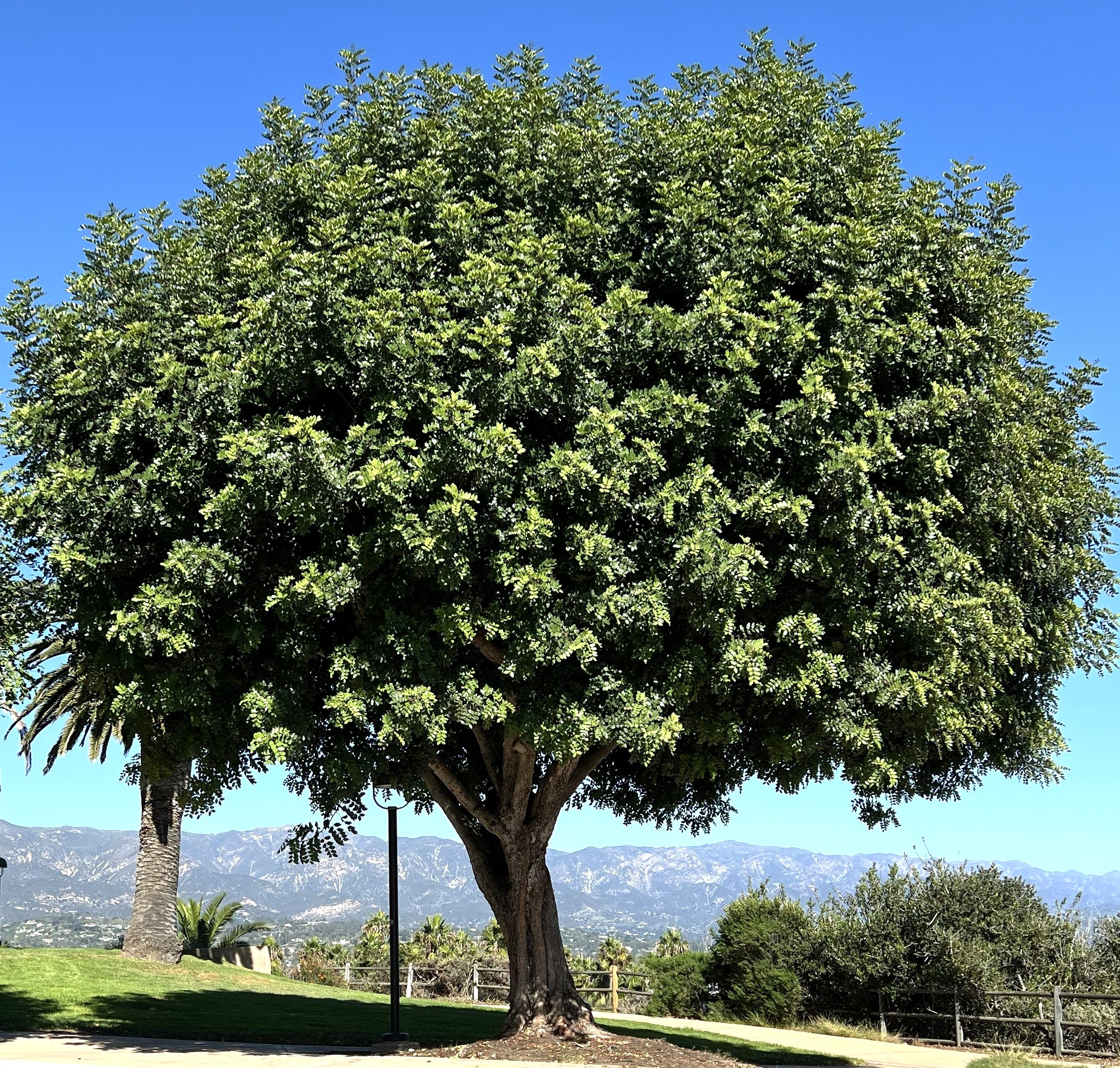
In our Mediterranean climate, Carob Tree grows slowly to become a handsome, uniformly shaped, small- to medium-sized tree (25- to 40-feet high), bearing a rounded crown (20- to 35-feet wide), with single or multiple trunks.
It is covered with glossy, dark green, pinnately compound leaves (5- to 12-inches long). The leaves are comprised of 4 to 8 pairs of leaflets that are ovate to elliptical in shape (1- to 3-inches long and 1- to 2-inches wide).
As the tree matures, the trunk develops a distinctive twist with deep furrows on the surface. When young, the bark is grayish brown; with age, it turns darker gray with rough scales.
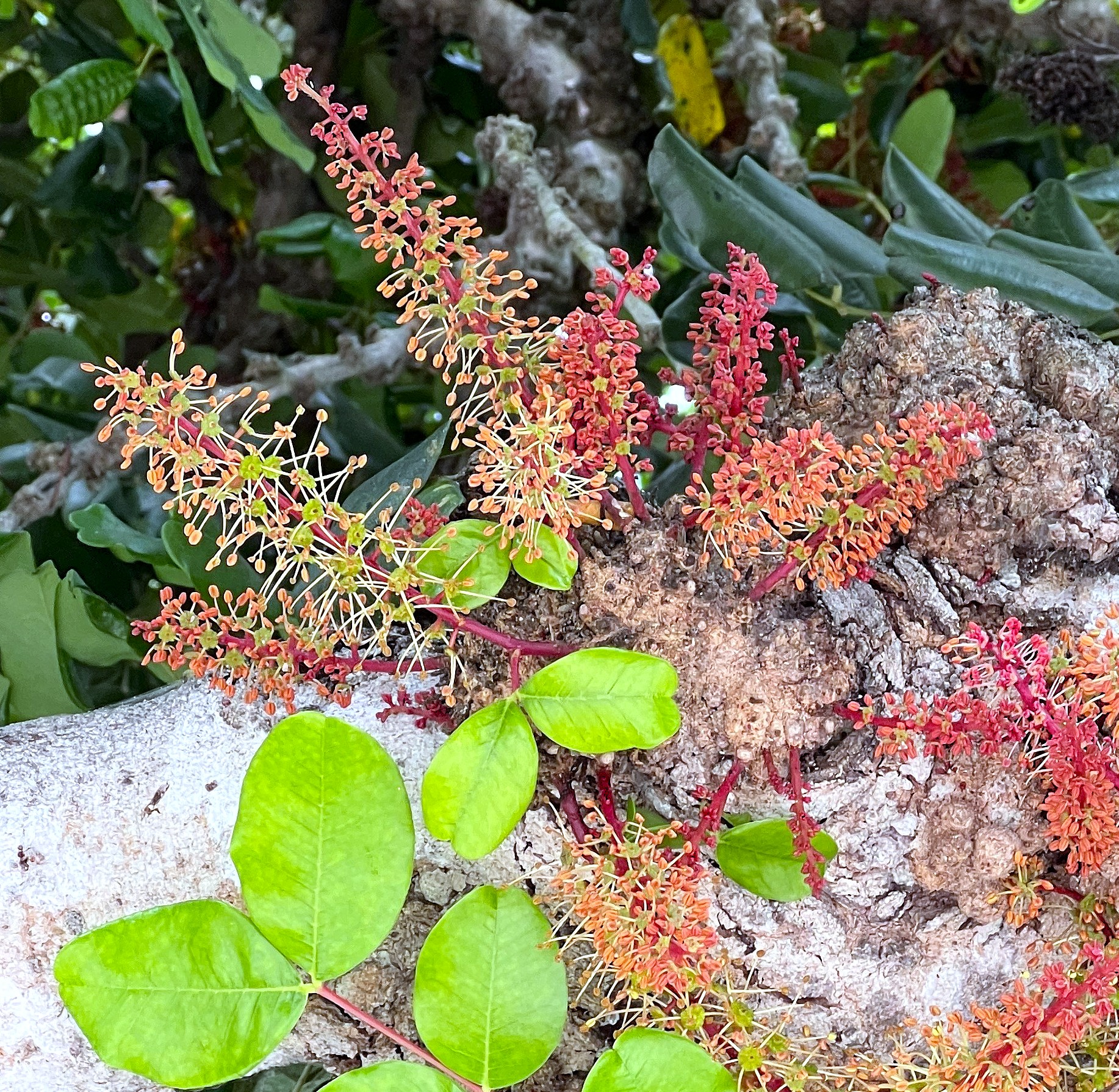
 The flowers are well hidden within the interior of the tree canopy. From June to September, depending on the weather, tiny flowers appear on catkin-like racemes (1- to 6-inches long and 1/3- to 1-inch wide) that emerge from short spurs on older stems, branches, or even the trunk. Each raceme can bear 20 to 60 diminutive, petal-less, flowers. Carob Tree is typically “dioecious” (female flowers and male flowers are found on separate trees) – but can occasionally be “monecious” (both male and female flowers and/or perfect flowers are found on the same tree). Pollination is done by the wind or by insects.
Carob Tree is planted in Santa Barbara primarily for its stately appearance in the landscape. However, worldwide, it is best known and cultivated simply for its seed pods. From September to November, its thick string-bean-shaped pods (4- to 6-inches long) form in clusters. Of course, the seed pods only occur on female and/or monecious trees.
It can take up to a year for the seed pods to mature. When young, they are straight, smooth, and green; when mature, they become curved, wrinkled, and dark brown. When ripe, they do not split open to drop their seeds; instead, they fall to the ground intact – where they are eagerly eaten by animals – and subsequently disbursed with a dollop of fertilizer.

The pulp within the seed pods has a heavy, sweet smell; in fact, the pods contain more sugar than sugar beets or sugarcane. The dark brown oval seeds inside the pods are 1/3-inch long; these are so uniform in size and weight that it has been reported that they were the original jeweler’s “carat” weight.
Carob Tree is endemic to Oman on the Arabian Peninsula. It has been widely cultivated for many centuries and is now naturalized throughout much of the Middle East and the Mediterranean.
Its common name, “Carob”, comes from the Arabic word “kharrub”, meaning “locust bean pod”. Another common name is “St. John’s Bread” – referring to the belief that it was eaten by Saint John the Baptist while wandering in the wilderness. It is in the Fabaceae (pea or bean) plant family. Its genus name, Ceratonia, comes from the Greek word “keratonia”, the name for the Carob Tree. The specific epithet, siliqua, comes from Latin and means “curved pod”, referring to the shape of the mature seed pods.
Humans have used Carob throughout recorded history, primarily as food for personal consumption, as feed for livestock, and for firewood. The pods have a remarkably high sugar content and a sweet flavor. After drying (and often roasting), they can be broken into chunks or ground into a fine powder, which can be used as a substitute for chocolate – for use in cooking, for hot drinks, for processing into a syrup used as a sweetener, or for the creation of a delicious liqueur. The gum from the seeds is used in food, cosmetics, and pharmaceuticals. The wood is used in making furniture and for carving, due to its wavy grain and resistance to splitting.
Carob Tree grows best with full sun in deep, well-drained, sandy loam soil – but it does seem to survive in a wide variety of soil conditions, including rocky and nutrient-poor soils. When first planted out in our community, it will require supplemental irrigation. When established, it will do quite well on our limited natural rainfall and can survive with annual rainfall of less than 12 inches. Fortunately, it is easy to grow, since it apparently has no serious insect or disease problems. Older foliage is tolerant of salt spray and is cold tolerant to 18 degrees Fahrenheit; new foliage is frost sensitive.
Fallen seed pods can be messy. Of course, male trees are pod-free and should be planted in high traffic areas. Older trees can develop large surface roots; it is wise to provide sufficient space to accommodate their future growth.
Carob Tree is easily propagated from seed, although the gender and nature of the baby trees will be unknown until their flowers appear. Obtaining a new tree of the preferred sex and the best growth characteristics would require either grafting or air-layering.
Carob Tree is a handsome specimen tree, perfect in water-conserving landscapes for gardens, parks, and commercial landscapes. Planted in multiples, it can also be utilized as a large hedge for privacy and screening.
There are many places in town to see these magnificent trees: some of the best specimens are on the SB City College campus (by the Administration Building and in the overlook lawn); several in upper Orpet Park; two in MacKenzie Park; as street trees, on Loma Street, on La Plata Street, on California Street; and a large tree on Chapala Street at W. Quinto Street.
Tree-of-the-Month articles are sponsored by Santa Barbara Beautiful, whose many missions include the increase of public awareness and appreciation of Santa Barbara’s many outstanding trees and, in a long-time partnership with the City Parks & Recreation Department, the funding and planting of trees along the City’s streets.
Those who wish to honor a special someone can do so with an attractive commemorative marker that will be installed at the base of an existing street tree in the City of Santa Barbara. Because Santa Barbara Beautiful has participated in the planting to date of over 14,000 street trees, there are plenty of trees from which to choose! Application forms are available on the Santa Barbara Beautiful website, www.sbbeautiful.org. This website also contains an archive of all previously published Tree-of-the-Month articles, including photos.
Article and Photos by David Gress