
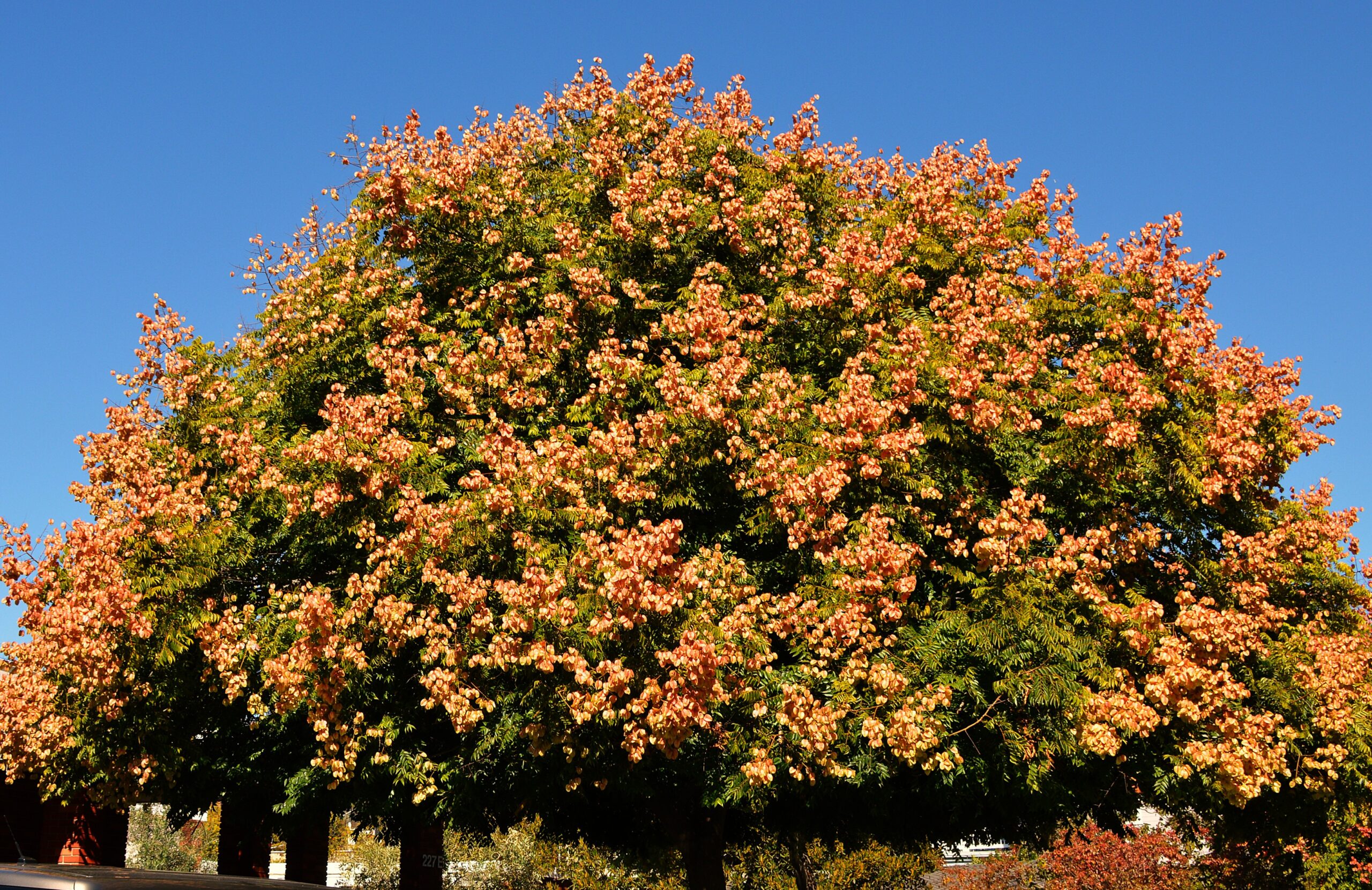
From summer through late fall, the Chinese Lantern Tree provides a spectacular display of color. It begins with spikes of brilliant yellow flowers – and continues as the flowers transform into luminous seed pods that resemble tiny Chinese paper lanterns.
It is no wonder that this decorative ornamental has been planted in Santa Barbara for more than a century and is still quite popular. It was first introduced here (and the United States) in 1911 by one of our pioneering horticulturists, Dr. Francesco Franceschi.
This exceptional tree is particularly suitable for our community, due to its small to medium size and its low-maintenance requirements. Fast growing when young, it forms a broad spreading crown with an ultimate height and spread of 25 to 50 feet. One of its many desirable features: it retains a rather full and symmetrical crown – with little or no pruning.
After a brief deciduous period in the winter, in spring the crown develops extraordinarily large (11- to 12-inches long and 9- to16-inches wide) dull dark green leaves, which are bipinnately compound (twice divided) – each leaf bearing up to 50 to 100 oblong drooping leaflets (3-inches long and 1½-inches wide)! When young, the bark is light brownish-gray and almost smooth; at maturity, it turns a darker gray with shallow fissures and breaks into small rectangle plates and scales on trunks and larger stems.
 Beginning in June through September, large sprays of upright panicles (18- to 24-inches long and 8- to 18-inches wide) appear. These stand upright above the canopy and bear thousands of small bright yellow flowers. The flowers are considered “perfect”, meaning they have both male and female flower parts.
 Pollinated flowers will begin to develop three-lobed, rather puffy, seed capsules (1- to 2-inches long), which quite resemble a lovely Chinese paper lantern. Inside the capsules there are six, hard, spherical, dark brown seeds (each up to 1/4-inch diameter), two on each lobe.
 Throughout summer, the canopy will be covered with a striking juxtaposition of the bright yellow flowers and the developing rose-pink seed capsules. As fall progresses, the dominant feature will be the mature seed capsules, which turn a delicious combination of colors – from a salmon pink to a yellowish tan.
This lovely tree is native to southern and eastern China. Locally, its common name is “Chinese Lantern Tree”; elsewhere, it is commonly named either “Chinese Flame Tree” or “Bougainvillea Goldenrain Tree”. It is in the Sapindaceae (Soapwort or Soapberry) plant family. The genus name, Koelreuteria, honors Joseph Gottlieb Koelreuter (1733-1806), a German professor of natural history and a pioneering plant hybridizer. Its specific epithet, bipinnata, refers to its bipinnately compound leaves.
Chinese Lantern Tree is easy to grow. It can readily be propagated from seed – and will germinate in several weeks, if the seeds are soaked in water overnight before planting. It prefers locations with full sun – but will do well in partial shade. It will accept most soil types – but does best when planted in a mildly acidic, well-drained, deep sandy loam. It seems to develop best as a single-trunked tree. It requires minimal pruning.
While reasonably drought-tolerant, it will appreciate irrigation in the dry season or in extended droughts. Relatively cold-tolerant, it can survive in the coldest of our local microclimates. Happily, it is not known to be affected by any serious insect pests or diseases. An added bonus: its roots are usually deep and non-invasive, so they are not likely to upturn paving or other hardscape.
The Chinese Lantern Tree makes a perfect addition to landscapes of all uses and sizes. In our area, it is frequently planted as a street tree and in commercial locations, especially in parking lots. In small formal or informal gardens, it is wonderful as a single focal point.
There are many mature examples of Chinese Lantern Tree in our community: as street trees, in the 1200 to 1900 blocks of Gillespie Street (mixed with Brachychiton); as street trees, on Kimberly Avenue; as shade trees, on Nathan Road; as shade trees, in the front lawn of Franklin School (Mason Street side); in the front lawn at 227 East Arrellaga Street; in the La Cumbre Plaza Parking lots; and, as specimen trees, in Franceschi Park (between the main house and the cottage).
Tree-of-the-Month articles are sponsored by Santa Barbara Beautiful, whose many missions include the increase of public awareness and appreciation of Santa Barbara’s many outstanding trees and, in a long-time partnership with the City Parks & Recreation Department, the funding and planting of trees along the City’s streets.
Those who wish to honor a special someone can do so with an attractive commemorative marker that will be installed at the base of an existing street tree in the City of Santa Barbara. Because Santa Barbara Beautiful has participated in the planting to date of over 14,000 street trees, there are plenty of trees from which to choose! Application forms are available on the Santa Barbara Beautiful website, www.sbbeautiful.org. This website also contains an archive of all previously published Tree-of-the-Month articles, including photos.
Article and Photos by David Gress