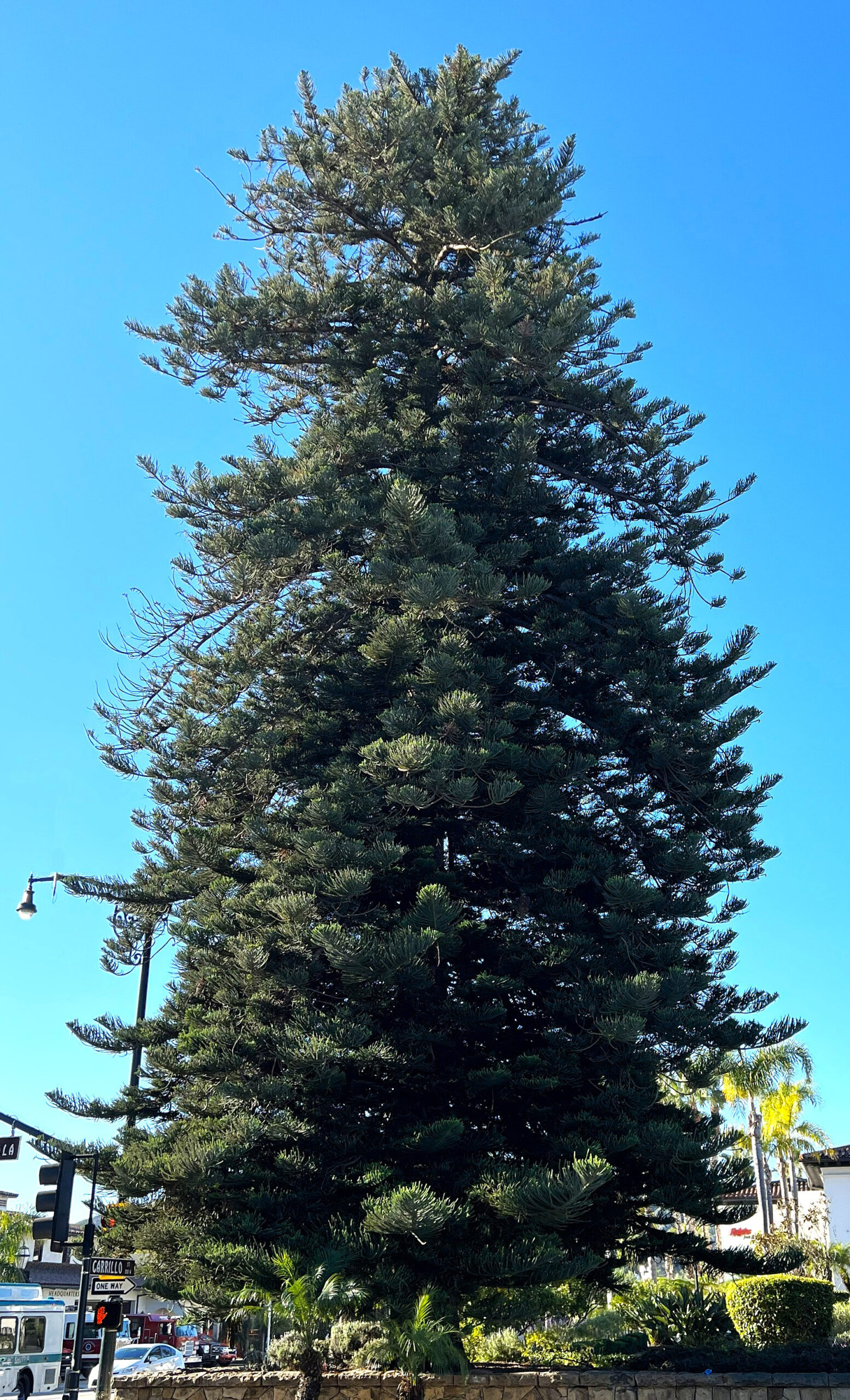
Santa Barbara’s skyline is punctuated with the upper spires of handsome trees commonly called “Norfolk Island Pine”. Because of their star-shaped top whorl of branches, they have another common name, “Star Pine”.
The most easily recognized one in town, “Santa Barbara’s Tree of Light”, stands majestically on the corner of Carrillo and Chapala Streets. It is remarkably healthy, given that it is almost 150 years old and about 120 feet tall – the height of a 12-story building!
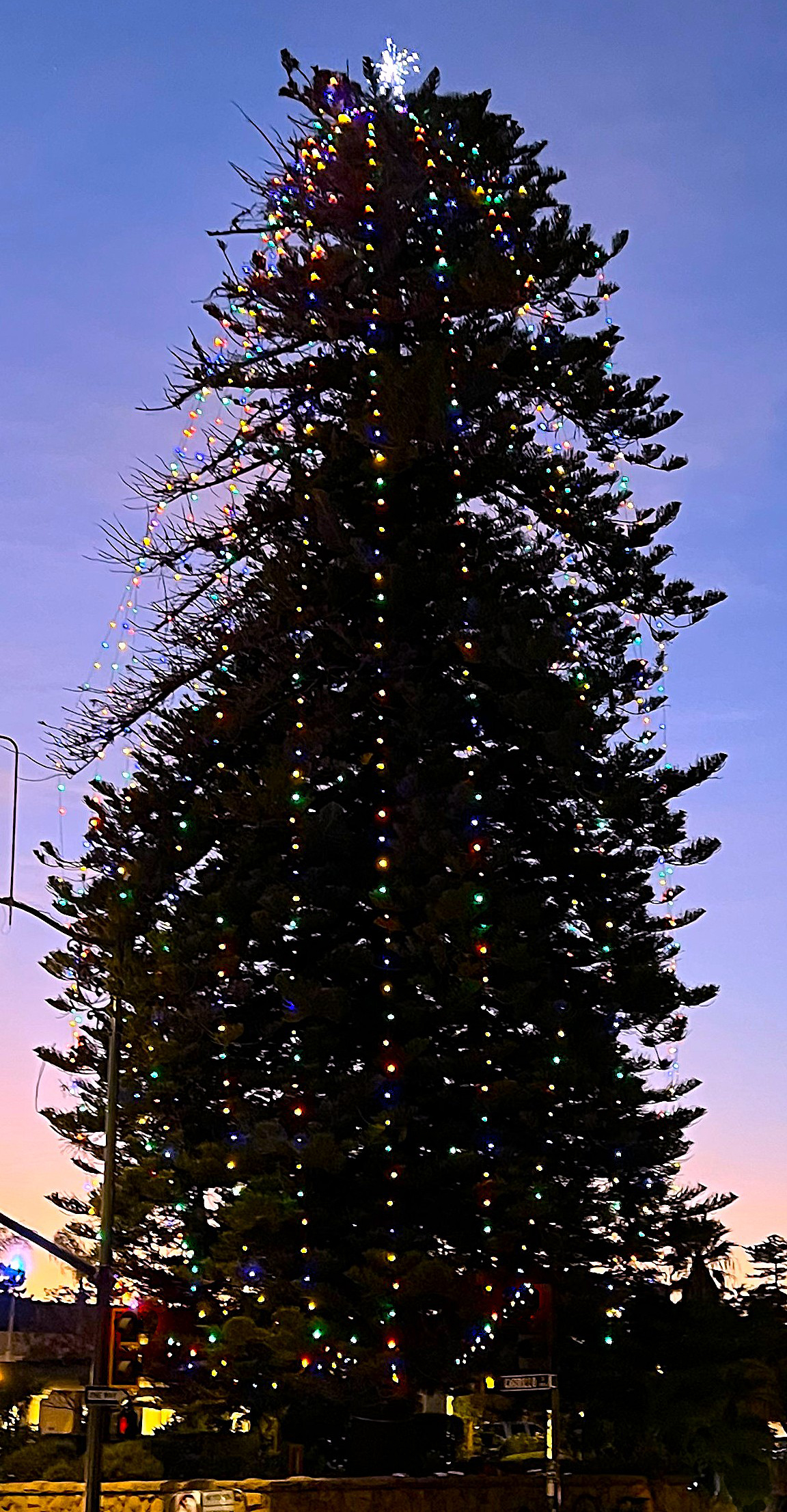
Every December – for the last 97 years – members of the International Brotherhood of Electrical Workers, Local Union 413, have decorated this tree’s boughs with strings of lights and placed a shining star at the very top, making it truly a “Star Pine”.
In 1878, this iconic tree was planted by Dr. and Mrs. Robert Winchester in what was then their front yard. In 1928, the Community Arts Commission designated it as the City’s official Christmas Tree. In 1977, the City Council designated it an official City Landmark.
The Norfolk Island Pine is a majestic conifer that can reach heights of 200 feet tall in its native homeland, Norfolk Island, which lies off the coast of Australia in the South Pacific. Despite being native to a remarkably tiny island (an area of only 14 square miles!), this tree is now widely grown in tropical, sub-tropical, and Mediterranean climates around the world – and as far north as Ireland.
Despite its common names, it is not a true pine (which is in the Pinus genus). It is in the Araucariaceae plant family of conifers, all of whose members are native to the Southern Hemisphere. Its botanical name is Araucaria heterophylla. The genus name, Araucaria, refers to the Araucanian Indians of central Chile, where tree relatives of Norfolk Island Pine are native. The specific epithet, heterophylla, is a combination of Greek words, which together mean “different-leaved”, referring to the striking differences in its juvenile leaf form and its and adult leaf form.
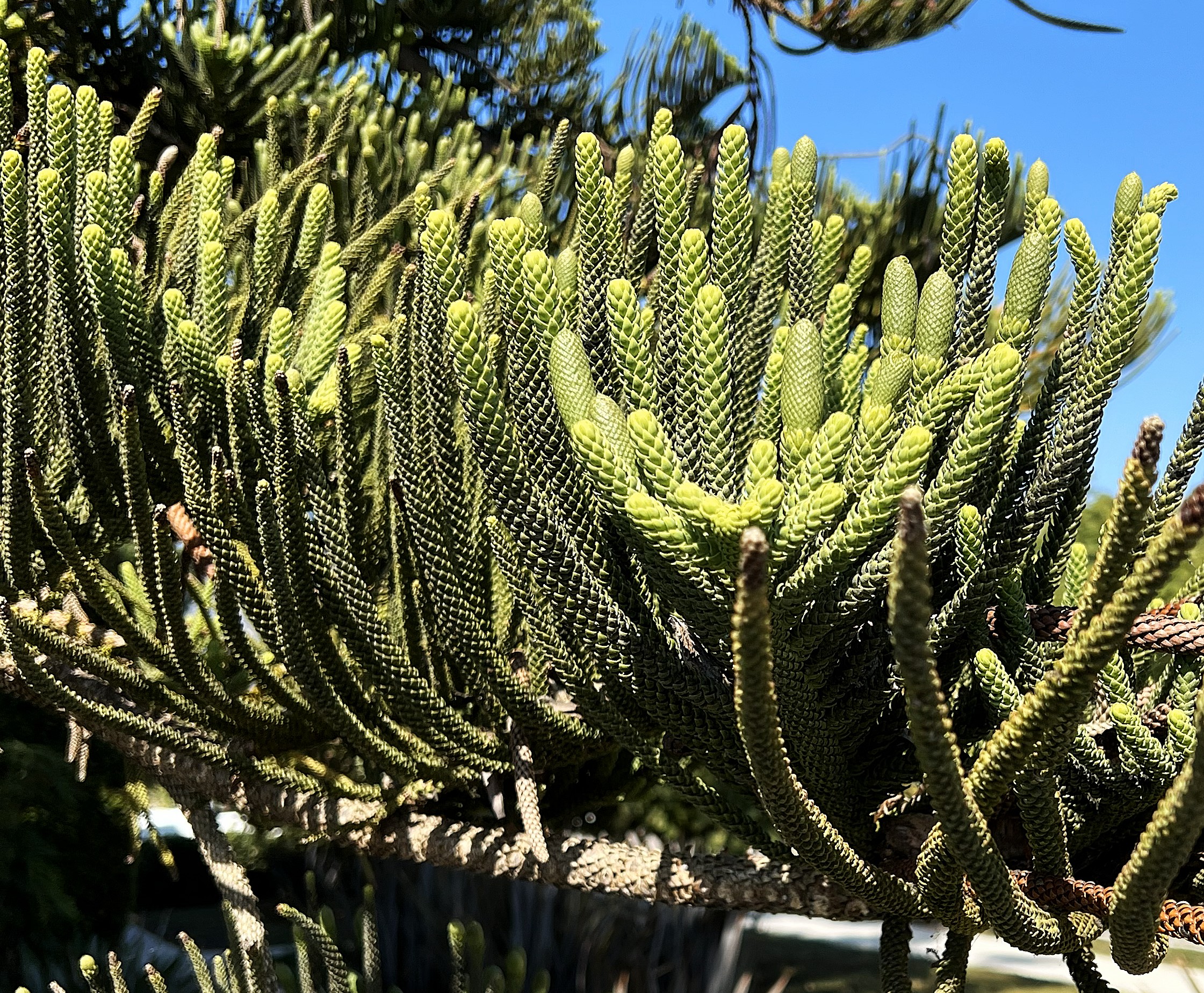 On long horizontal branches, twigs stand erect and point to the sky – from a distance, they resemble upward-facing combs. On the twigs, juvenile leaves can be up to ½-inch long, are spirally arranged, extend away from the stem, and have sharp, pointed ends. As they become adult leaves, they change quite distinctly – widen, flatten, and become scale-like, incurved, and overlapping. When fully covered with mature scaled leaves, the twigs can reach up to 2 feet in length, appear to have been carefully braided, and are surprisingly sleek to the touch.
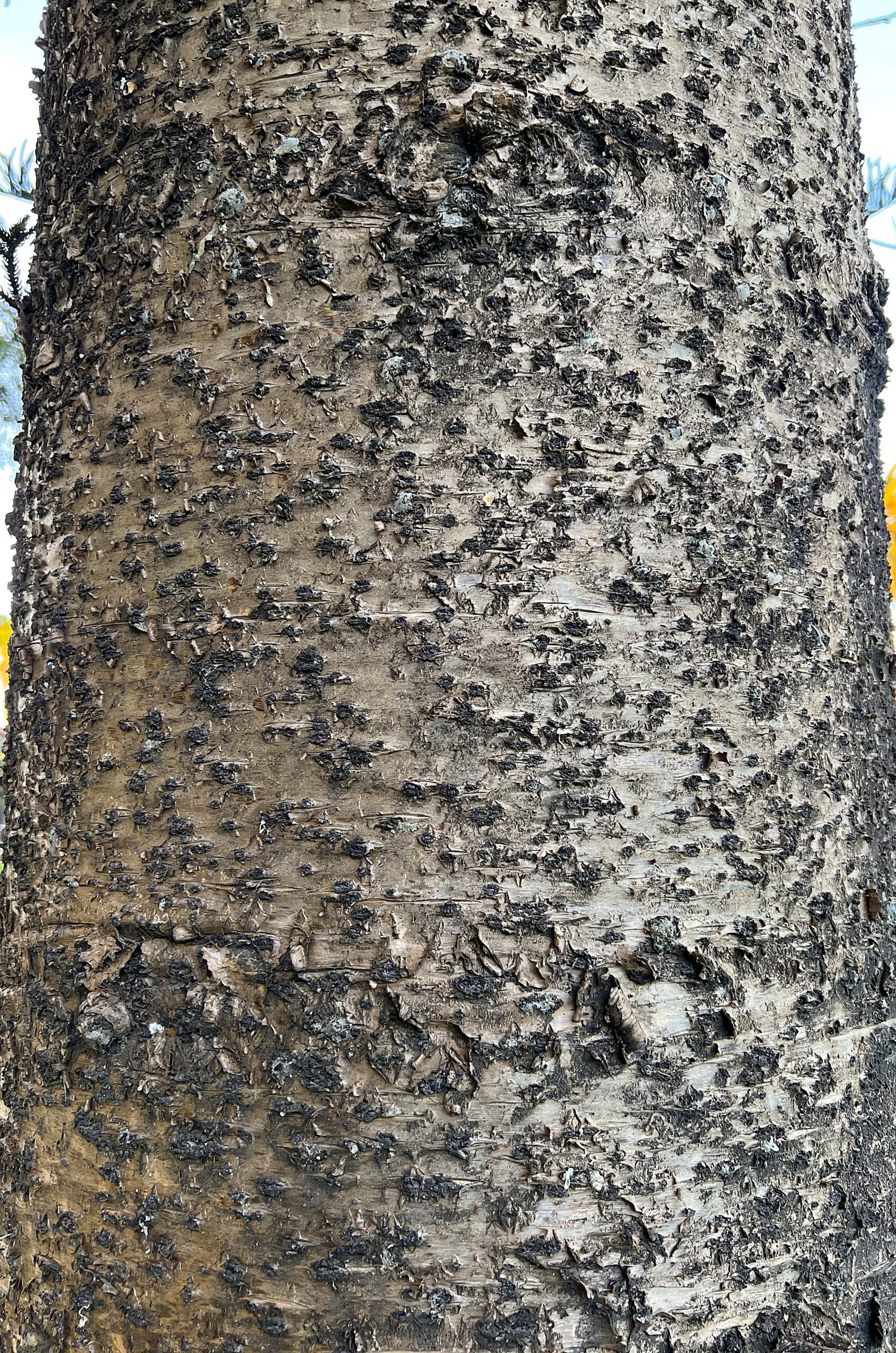
Norfolk Island Pine is notable for its symmetrical form, with whorls of horizontal branches widely spaced apart along an otherwise bare, straight, single trunk. Its dark brown to black bark is rough and peels off in thin layers.
 It is “monoecious”, meaning male cones and female cones appear on the same tree. It bears cylindrical male pollen cones (2-inches long) and nearly-round (3- to 6-inches diameter), spiny, female seed cones.
Being adaptable to a broad range of climates and soil, it grows well in Santa Barbara. It can survive on our normal rainfall – but looks better if provided with irrigation in the dry season and during droughts. To accommodate its roots and massive size at maturity, it needs to be provided with a large space in any landscape. Fortunately, it does not seem to be bothered by any serious disease or insect pests. Certainly, a star of a tree, by any name!
Specimens of mature Norfolk Island Pine can be seen in many places around town: on the southwest side of the County Courthouse (at the corner of Anacapa Street and E. Figueroa Street); in East and West Alameda Parks; at the Santa Barbara train station; on the grounds of Our Lady of Sorrows Church (Anacapa Street at E. Arrellaga Street); at 815 Quinientos Street; in private yards in the Upper East side; at UCSB; and, of course, at the corner of Carrillo and Chapala Streets.
Tree-of-the-Month articles are sponsored by Santa Barbara Beautiful, whose many missions include the increase of public awareness and appreciation of Santa Barbara’s many outstanding trees and, in a long-time partnership with the City Parks & Recreation Department, the funding and planting of trees along the City’s streets.
Those who wish to honor a special someone can do so with an attractive commemorative marker that will be installed at the base of an existing street tree in the City of Santa Barbara. Because Santa Barbara Beautiful has participated in the planting to date of over 14,000 street trees, there are plenty of trees from which to choose! Application forms are available on the Santa Barbara Beautiful website, www.sbbeautiful.org. This website also contains an archive of all previously published Tree-of-the-Month articles, including photos.
Article and Photos by David Gress