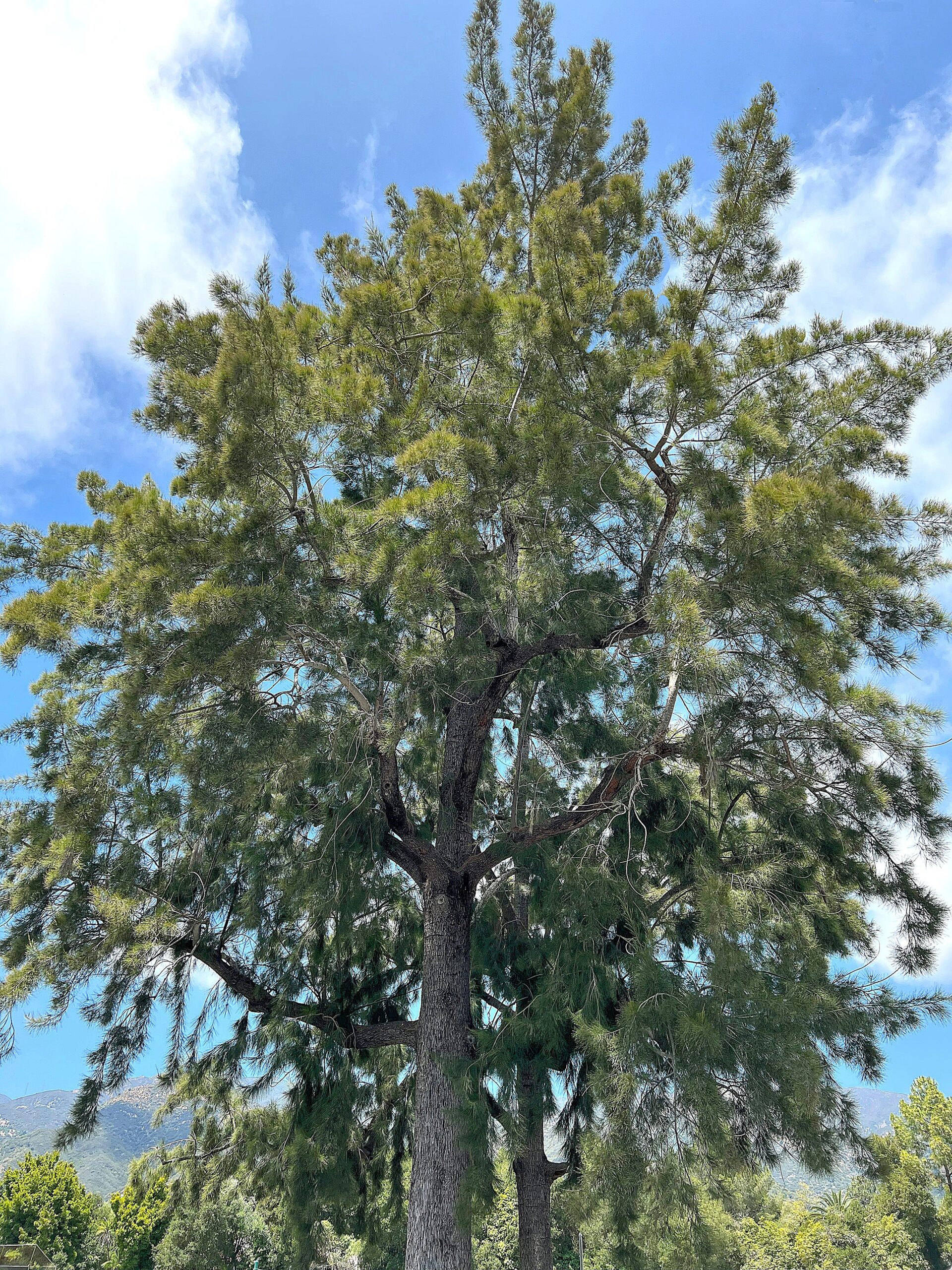
 River She-Oak is an evergreen tree that can be considered a master (or a mistress?) of illusion. It has a pine-like appearance – but is not a pine at all. It isn’t even any type of conifer (a “gymnosperm”), which reproduces through seed cones and pollen cones. It is, in fact, a flowering plant (an “angiosperm”) – and one of the very earliest to have evolved eons ago.
It does bear what seem to be pine needles – but these are not needles. They are modified stems (called “cladodes”), which are quite long (4- to 12-inches), soft to the touch, and contain the chlorophyll necessary for photosynthesis. The cladodes have segments (called “articles”) regularly spaced all along their lengths – and, consequently, resemble the segmented stems of horsetail plant (Equisetum). The cladodes grow along the branches in graceful downward alignment. It is a delight to stroke them – they feel like downy feathers.
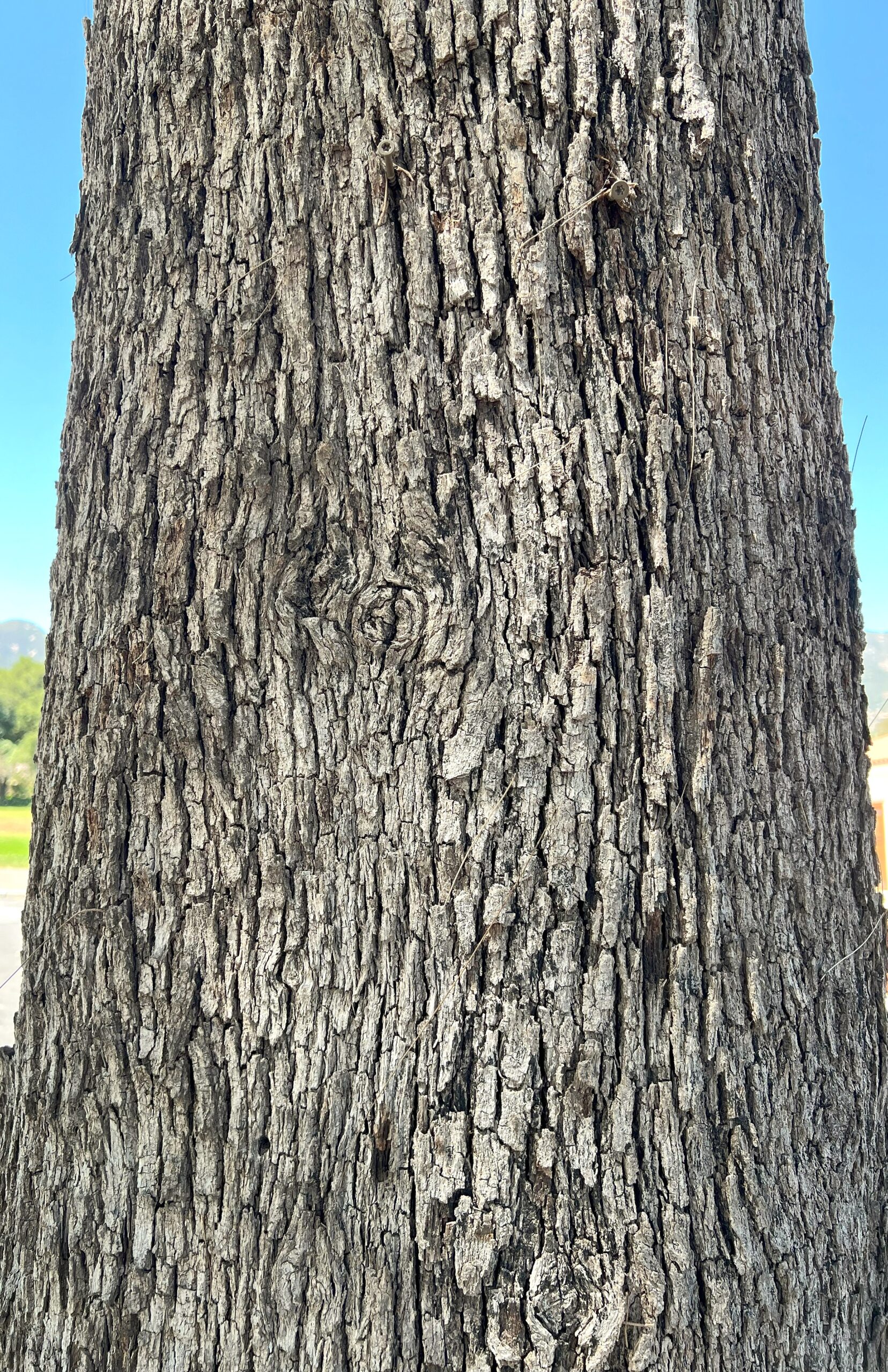
This stately single-trunked tree can reach a height of 70 feet with a spread of 30 feet. As it matures, it changes its growth habit dramatically – going from an upright tree of handsome symmetry to a rather gangly tree with an open canopy of irregularly drooping branches. Its attractive light gray-brown bark has shallow fissures and is sometimes scaly.
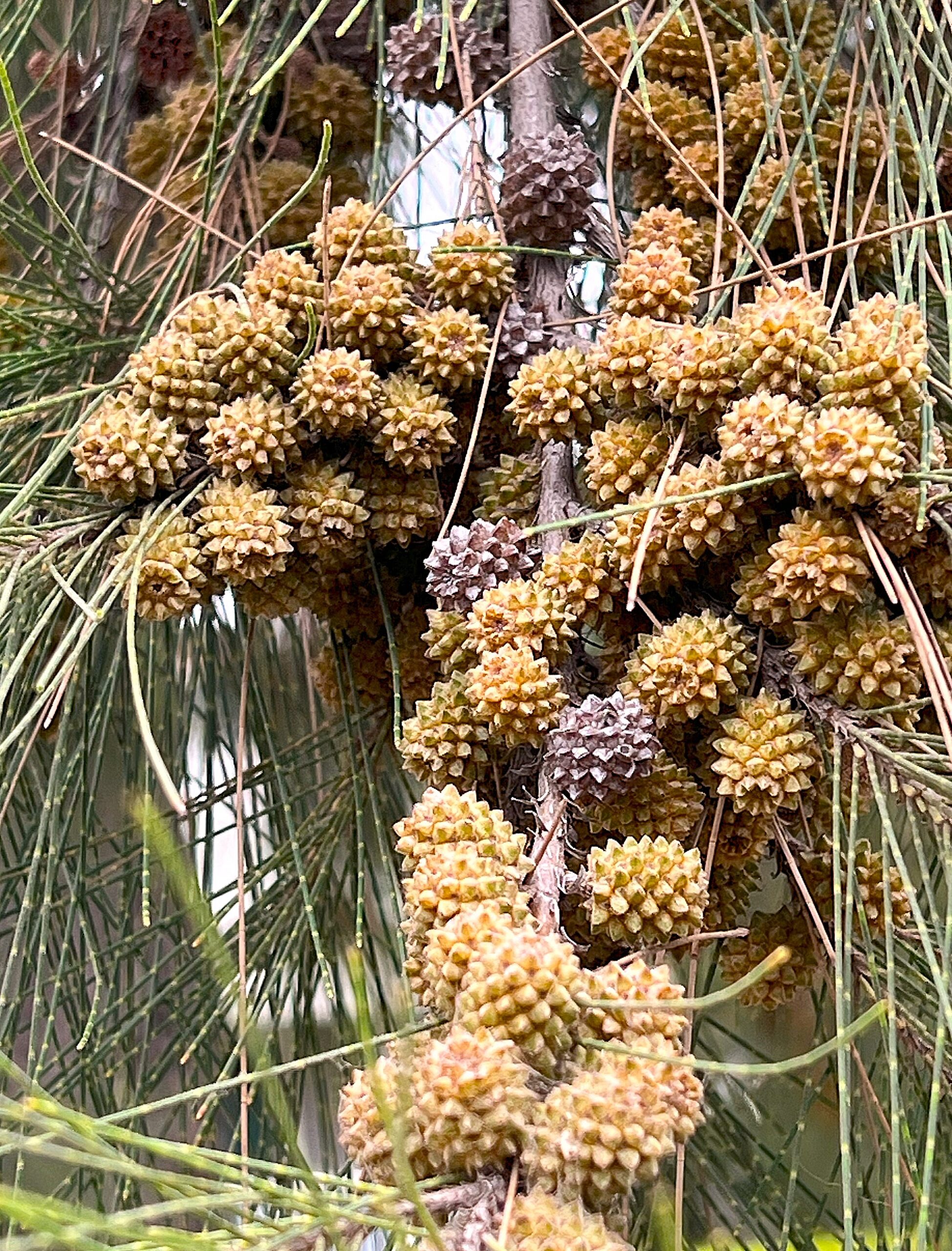
River She-Oak is “dioecious”, which means that male flowers occur on one tree and female flowers occur on a separate tree. The inconspicuous flowers appear in late winter or early spring. Male flowers develop on spikes (1-inch-long) at the ends of the branchlets that bear the cladodes. Female flowers are red and filament-like, oddly without petals; they appear on short stems (¼ to ½-inch-long) in clusters on branchlets and are wind pollinated. After pollination, female flowers develop round fruits (½-inch-diameter), which look a bit cone-like; when mature, these turn light brown, dry out, and crack open to release dozens of tan seeds (1/8-inch-long) each bearing a single wing for dispersal through flight.
River She-Oak is endemic to the tropics and subtropics of Australia and New Guinea. Its common name refers to the fact that in its native areas it is “riparian” (growing primarily along rivers, streams, and bodies of freshwater) and to the fact that its wood has a beautiful grain that is similar to that of true oaks (Quercus), being only slightly softer. Its other common names include “River Oak”, “Creek Oak”, and “Australian Pine”.
Where River She-Oak is indigenous, it is harvested as a valuable timber tree and planted for windbreaks, erosion control, reforestation, and screening.
It is in the Casuarinaceae (She-Oak) plant family. Its botanic name is Casuarina cunninghamiana. The genus name, Casuarina, is derived from the name of the Australian flightless bird, the cassowary (genus Casuarius), because the tree’s soft stems resemble (and feel like) the bird’s long feathers. The specific epithet, cunninghamiana, honors the Australian botanist and explorer, Alan Cunningham (1791-1839).
Over the decades, several different species of Casuarina have been imported into the Santa Barbara community; they all grow quite well in our Mediterranean climate. Casuarina cunninghamiana is now the most commonly planted Casuarina here, primarily as an ornamental landscape tree.
River She-Oak is easy to grow, because it is adaptable to many types of soil and is quite drought tolerant. It tolerates brackish water and salt spray. It is also resistant to any serious insect or disease problems.
It is a good tree for difficult sites – where other trees would not thrive. It is certainly suitable for parks, street plantings, large private gardens, and commercial landscapes.
Mature River She-Oaks can be seen as street trees on Cota Street (from Chapala Street to Garden Street), in Vera Cruz Park, in Sylvan Park, as specimen trees in the grounds of Cold Spring School, as a fine grove on the south side of the 6000 block of Hollister Avenue (Santa Barbara Airport property), and in Ganna Walska Lotusland (just inside the old gate on Sycamore Canyon Road).
Tree-of-the-Month articles are sponsored by Santa Barbara Beautiful, whose many missions include the increase of public awareness and appreciation of Santa Barbara’s many outstanding trees and, in a long-time partnership with the City Parks & Recreation Department, the funding and planting of trees along the City’s streets.
Those who wish to honor a special someone can do so with an attractive commemorative marker that will be installed at the base of an existing street tree in the City of Santa Barbara. Because Santa Barbara Beautiful has participated in the planting to date of over 14,000 street trees, there are plenty of trees from which to choose! Application forms are available on the Santa Barbara Beautiful website, www.sbbeautiful.org. This website also contains an archive of all previously published Tree-of-the-Month articles, including photos.
Article and Photos by David Gress