
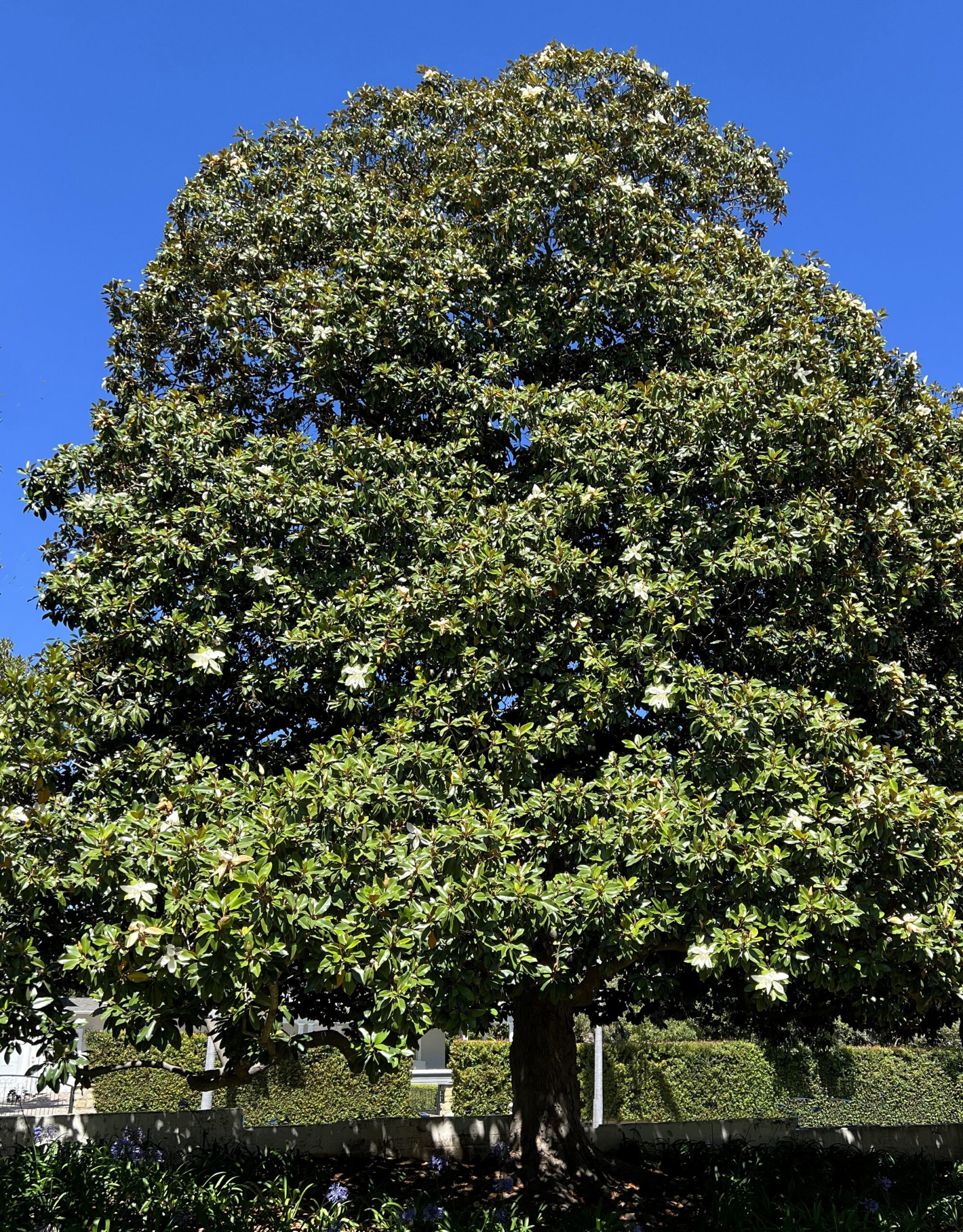
Southern Magnolia is a broad-leafed evergreen tree that has been widely planted in Santa Barbara since its introduction here in the late 1800s. The magnificent specimens standing on San Andres Street are now over 100 years old. This species’ popularity is clearly due to its stately appearance, dense canopy of evergreen foliage, and stunning white flowers.
Its dense, rounded crown features ovate leaves with smooth edges that measure 5- to 10-inches long and 3- to 5-inches wide. The thick leaves are a glossy dark-green color on the upper surfaces – and often bear rust-colored soft hairs on the under surfaces. Given this remarkable color display, sprays of these beautiful leaves are often used in flower arrangements.
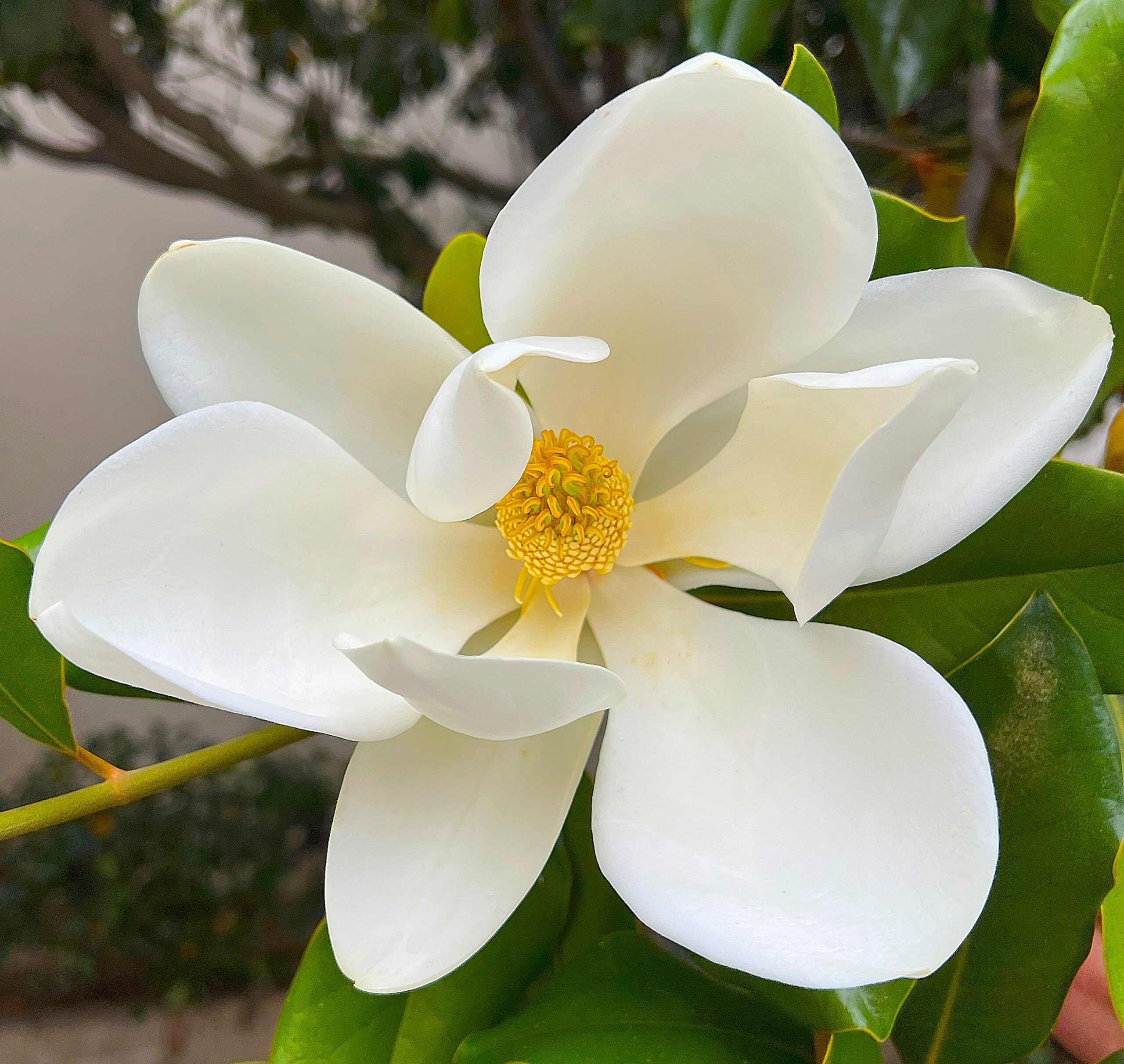
From June through September, pure white flowers appear, scattered amongst the dark foliage. These impressive blooms bear 6-12 thick petals and are quite large; each can be up to 12-inches across! These are considered “perfect flowers”, because each has a prominent yellow spike in the center that carries with both male and female sexual parts. They have a delightful fragrance that reminds one of a refreshing spring rain. Bees are the primary pollinators.
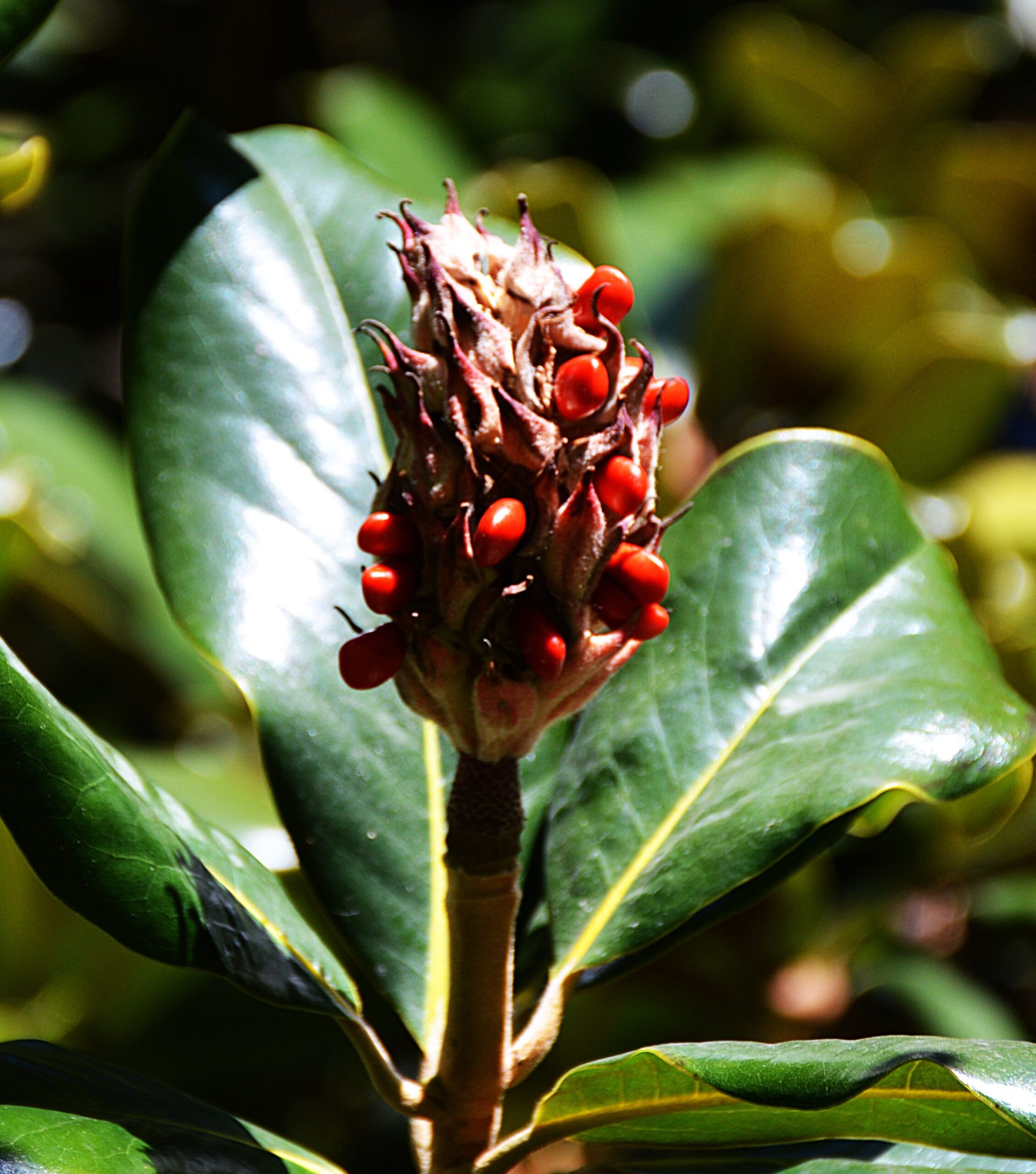
Pollinated flowers develop a long (3- to 5-inches) cone-like fruit, consisting of follicles covered with brown fuzzy hairs. When mature, each follicle will split open to reveal a shiny bright-red seed. The tasty seeds are eaten by hungry birds and other animals – and subsequently spread abroad with a dollop of fertilizer.
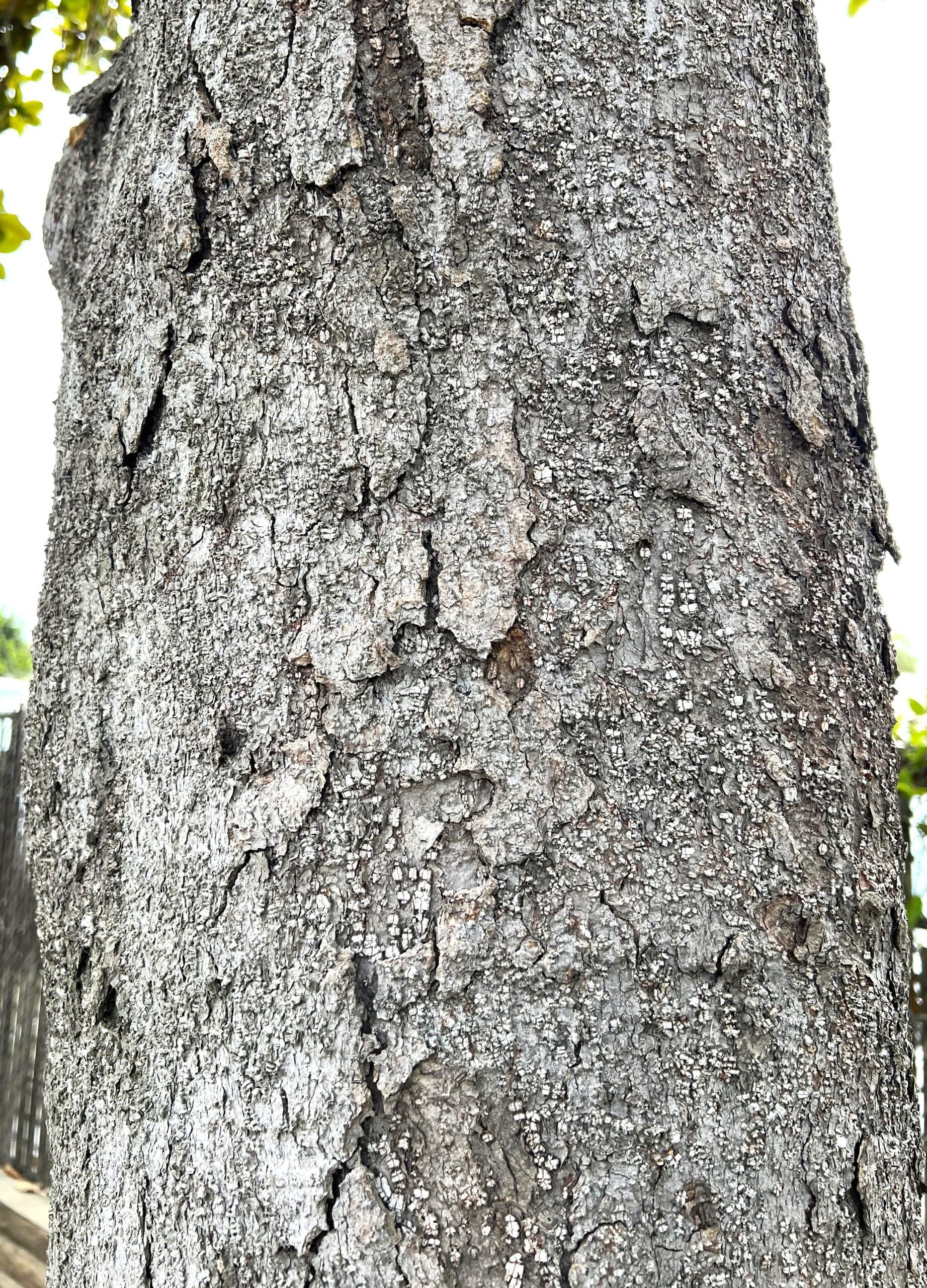
It is a slow-growing tree. However, at maturity, it can reach 50- to 60-feet in height and 45- to 50- feet in width. When the tree is young, its bark is light gray and smooth; with age, it will turn dark gray with long flaking scales.
“Southern Magnolia” is its common name in our community; in its native range, its other common name is “Bull Bay”. It is in the Magnoliaceae plant family and is known botanically as Magnolia grandiflora. The genus name, Magnolia, honors the French botanist Pierre Magnol (1638-1715). The species name, grandiflora, is a combination of the two Latin words, “grandis”, meaning “big”, and “flor”, meaning “flower”, together meaning “large or beautifully flowered”.
Southern Magnolia is endemic to the southeastern United States, from Virginia to central Florida and eastern Texas, where it enjoys the moist, rich soils of the coastal plains. It demonstrates strong adaptability to our local Mediterranean climate, requiring only infrequent deep watering once established. It grows best in full sun and deep sandy loam soil. It requires very little pruning and is generally free from serious insect and disease infestations.
Seedling grown trees can be quite variable in size and growth habit. Consequently, many cultivars have been selected by horticulturists and propagated in the nursery trade by cloning; these offer shapes and sizes that can fit into almost any landscape. The cultivar named ‘Saint Mary’ is a medium-sized tree that grows only 20- to 25-feet tall with an equal spread; its leaves and flowers are also smaller than M. grandiflora.
Another outstanding smaller cultivar is named ‘Little Gem’. It is an adaptable, delightful, and sustainable even-smaller cultivar that has become widely planted in the last 20 years, because of its compact uniform growth habit and its low maintenance requirements. It grows in a rounded pyramidal shape to a height of only 15- to 20-feet with a spread of just 10- to 15-feet. It is also favored because, after planting out, it flowers quickly and over a longer period than other cultivars.
Other commercially available cultivars in our area that were selected for their desirable floral, foliage, and growth characteristics are ‘Majestic Beauty’, ‘Samuel Sommer’, and ‘San Marino’.
Given the wide selection of different cultivars, Southern Magnolia makes a perfect choice for gardens of all sizes. It can add a distinctive look to parks, streets, and commercial landscapes. It is a fine shade tree. It can also be trained as an attractive espalier against fences and walls, where space is limited.
Southern Magnolias are beautiful, slow growing, and long-lived trees, which certainly will continue to grace the streets and gardens of Santa Barbara for current and future generations to enjoy.
There are many examples of mature Southern Magnolias in our community. As street trees, they stand in the 800-1900 blocks of San Andres Street, in the 900 block of East Mason Street, in the 1100 block of Nopal Street, in the 900 block of Bath Street, in the 300-400 blocks of East Cota Street, 100 Block South to the 200 Block North Salsipuedes Street, and on Dixon Street. Two large specimens on the County Court House grounds. Several trees hold court in Alice Keck Park Memorial Garden. Several outstanding trees at Santa Barbara Street and Valerio Street.
Tree-of-the-Month articles are sponsored by Santa Barbara Beautiful, whose many missions include the increase of public awareness and appreciation of Santa Barbara’s many outstanding trees and, in a long-time partnership with the City Parks & Recreation Department, the funding and planting of trees along the City’s streets.
Those who wish to honor a special someone can do so with an attractive commemorative marker that will be installed at the base of an existing street tree in the City of Santa Barbara. Because Santa Barbara Beautiful has participated in the planting to date of over 14,000 street trees, there are plenty of trees from which to choose! Application forms are available on the Santa Barbara Beautiful website, www.sbbeautiful.org. This website also contains an archive of all previously published Tree-of-the-Month articles, including photos.
Article and Photos by David Gress