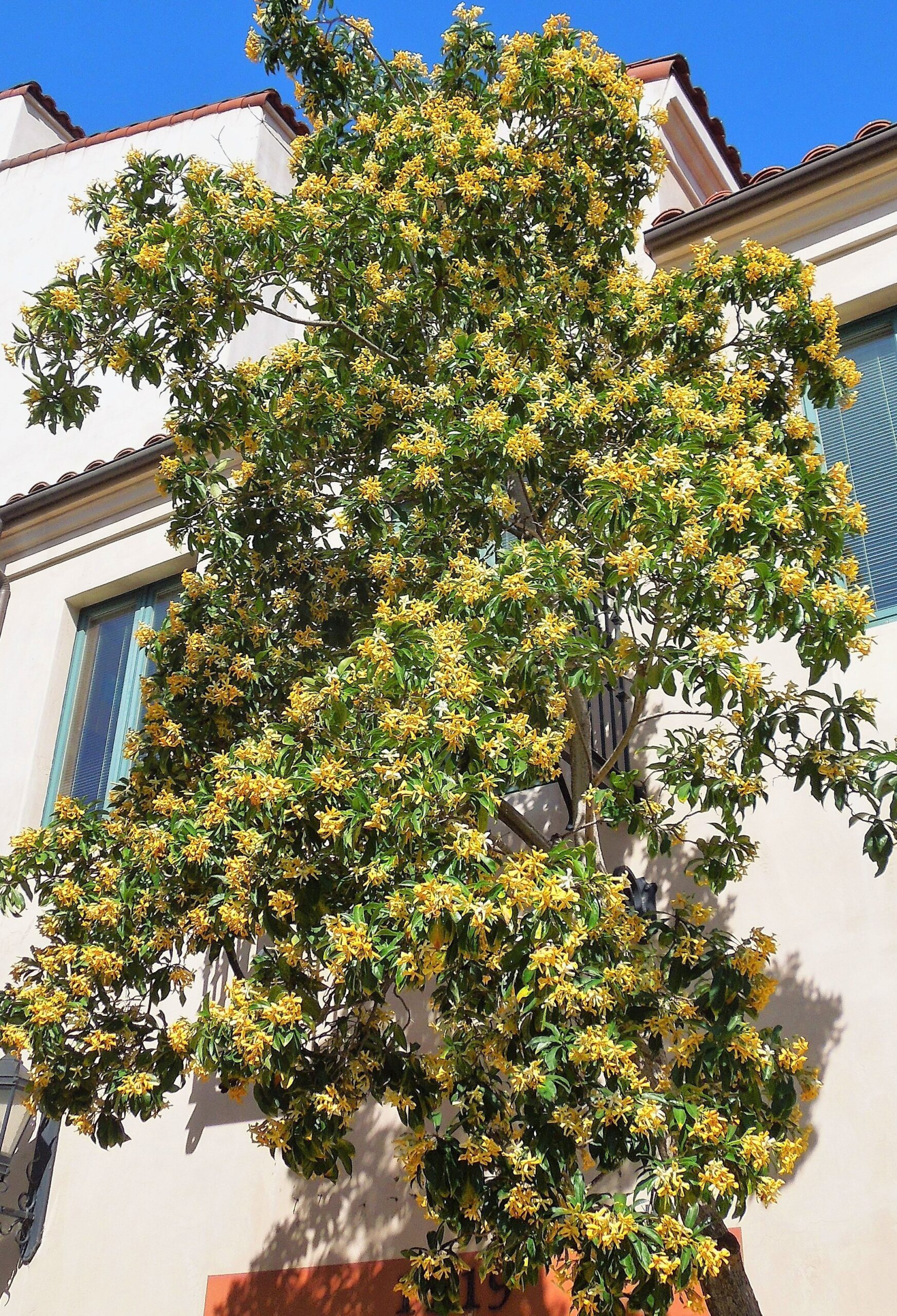
 The amazingly sweet perfume that drifts from the flowers of the Sweetshade Tree gives this lovely tree its name – a divine combination of the fragrances of Plumeria blossoms and orange blossoms.
Sweetshade Tree is a medium-sized broadleaf evergreen, which grows 25- to 40-feet tall and 15- to 20-feet wide; consequently, it fits nicely into narrow landscape spaces. Its growth habit is generally a slender and erect branching structure; however, its shape can become quite variable, open, and asymmetrical (read here “lumpy”), which can, nevertheless, add to the sculptural beauty of its mature trunk and branches. Gentle pruning to develop and maintain a regular shape may be needed.
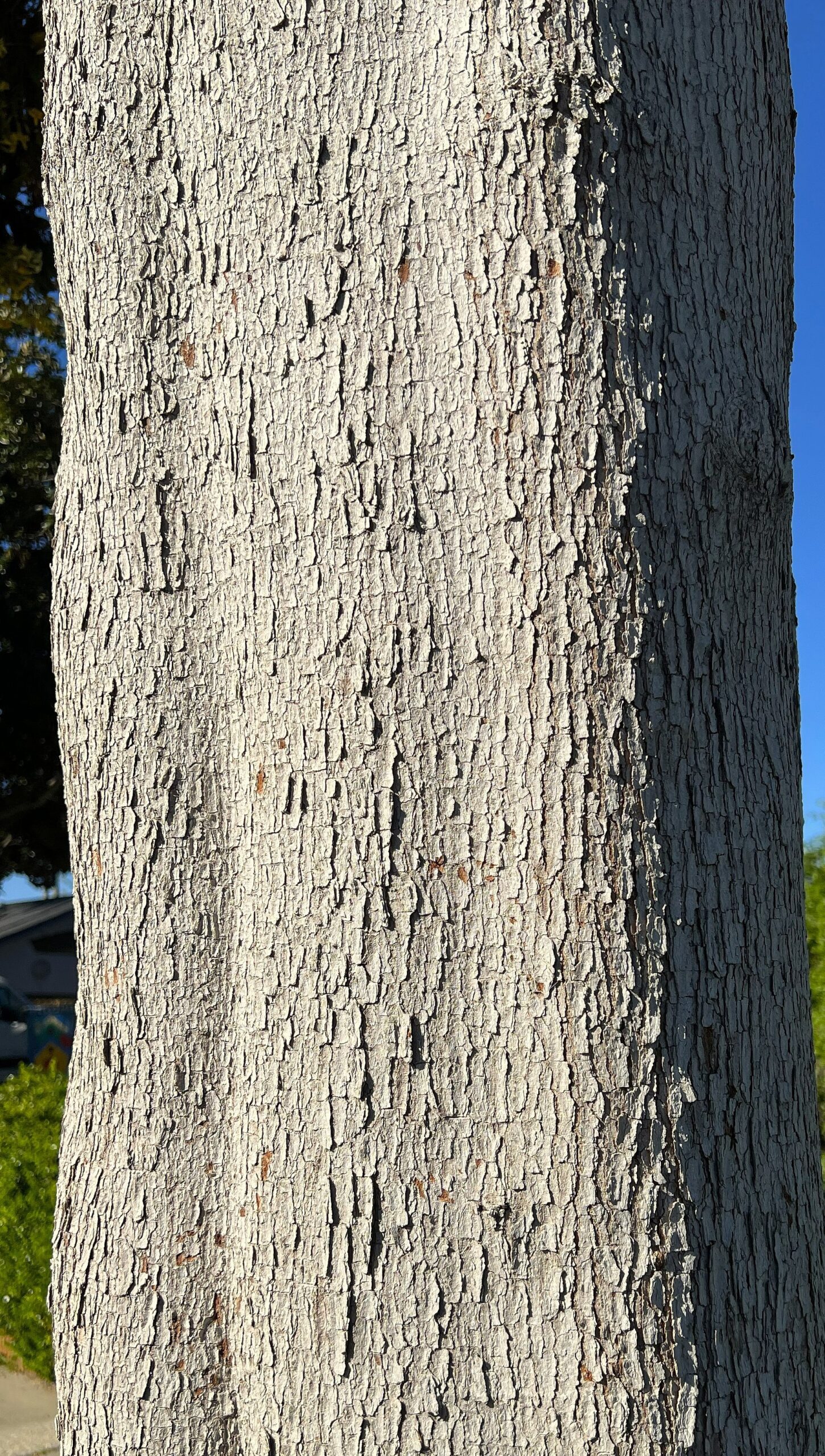
Branches are widely spaced and occur in whorls radiating out from the trunk. Being an evergreen tree, its shiny bright-green leaves (3- to 6-inches long and 1- to 1½-inches wide), make it attractive year-round. Its light-grey outer bark, flaking in small spots to reveal a cinnamon-brown inner bark, contrasts well with the lustrous foliage.
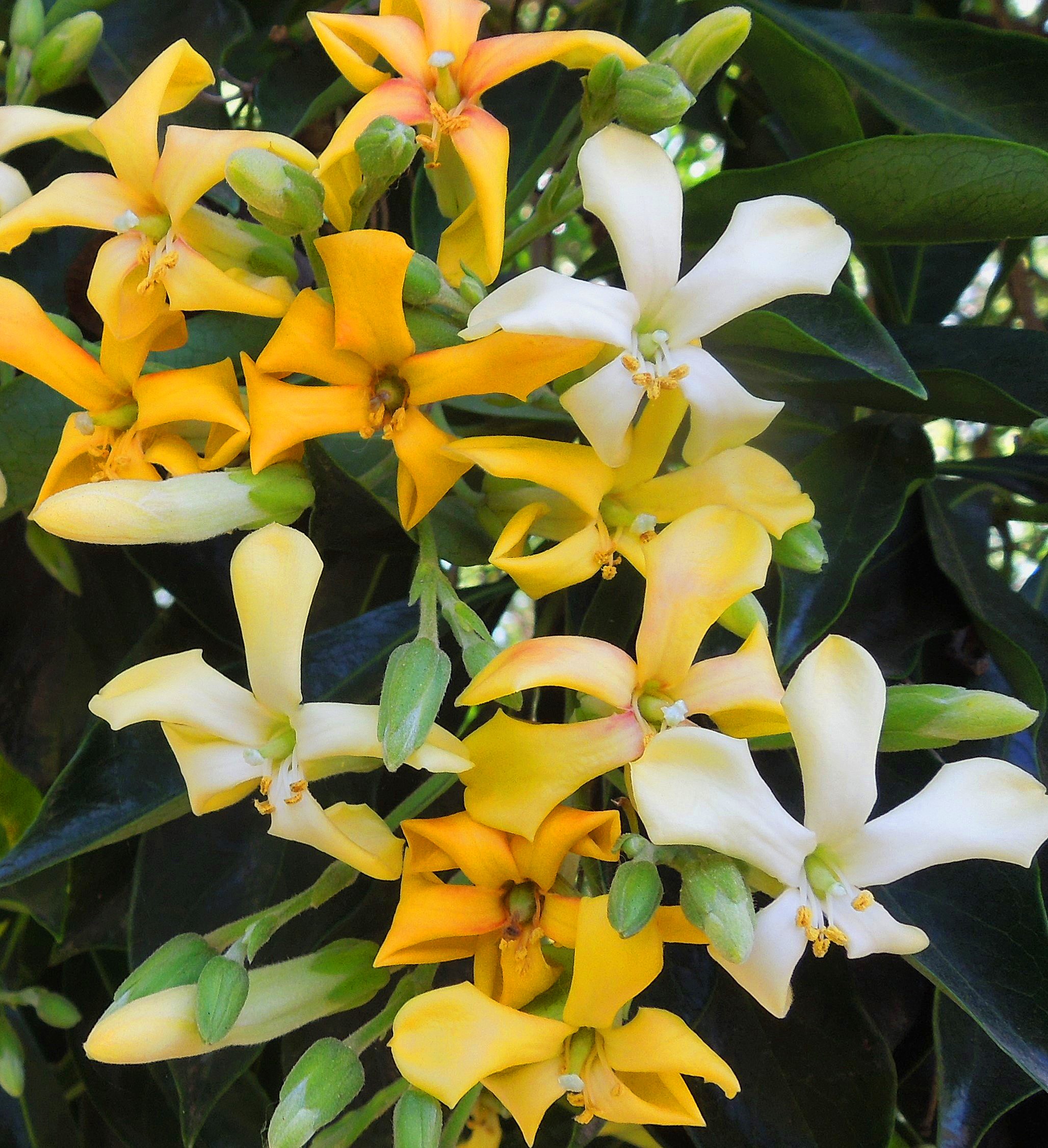
In our community, its delightfully fragrant flowers (1- to 2-inches long) will bloom from March through May – and can completely cover the tree in terminal clusters (up to 8-inches across) bearing up to 16 flowers per cluster. As the flowers age, their color changes from a creamy yellow, to a warm honey, and then to a dark gold. Their tasty nectar is devoured by bees, who happily assist in pollination.
Pollinated flowers form rounded oblong seed pods (1- to 1½-inches long) that, when ripe and dry, split open to release dozens of flat round seeds (½-inch in diameter); each seed is surrounded by a tiny paper-like wing and is dispersed in the wind.
In addition to its common name of “Sweetshade Tree”, it is also known by the common names of “Hawaiian Wedding Tree” and “Queensland Frangipani”.
Its botanical name is Hymenosporum flavum. The genus name, Hymenosporum, is derived from the combination of two Greek words – “hymen” (meaning “membrane”) and “spora” (meaning “seed”), referring to its winged seeds. The specific epithet name, flavum, is from the Latin word “flavus”, (meaning “yellow”), referring to the flower color. It is a member of the family Pittosporaceae, which includes the much more commonly available tree species in the genus Pittosporum that also bear fragrant flowers.
A native of Queensland and New South Wales in Australia and in New Guinea, the Sweetshade Tree has been a popular and widely planted landscape tree in Santa Barbara since it was introduced here in 1900 by Dr. Francesco Franceschi, one of our pioneering local horticulturists. In fact, the largest recorded Sweetshade Tree in California is a street tree located on Dibblee Avenue, which was planted in 1904 – still stands today – and still flowers beautifully.
Sweetshade Tree does prefer full sun – but can do well in partial shade. It is surprisingly drought-tolerant – but does much better with infrequent deep watering. It should be provided with well-drained soil. It is cold hardy to at least 20 degrees Fahrenheit for short periods. It can be planted as a single specimen or in groups for a more dramatic effect. It can be installed as a street tree or in commercial landscapes – and it makes a distinctive, fragrant addition to any home garden.
Fine examples of Sweetshade Trees are found in many places in Santa Barbara: in Alice Keck Park Memorial Garden; along the 1400-1600 blocks of Garden Street; on De La Vina Street (at Mission Street); on Anacapa Street (near Anapamu Street); on Dibblee Avenue; and, at Lotusland (near the Visitors’ Center). A truly magnificent street tree specimen towers in the 500 block of Hastings Drive in Goleta.
Tree-of-the-Month articles are sponsored by Santa Barbara Beautiful, whose missions include the increase of public awareness and appreciation of Santa Barbara’s many outstanding trees and, in a long-time partnership with the City Parks & Recreation Department, the funding and planting of trees along the City’s streets.
Article and photos by David Gress