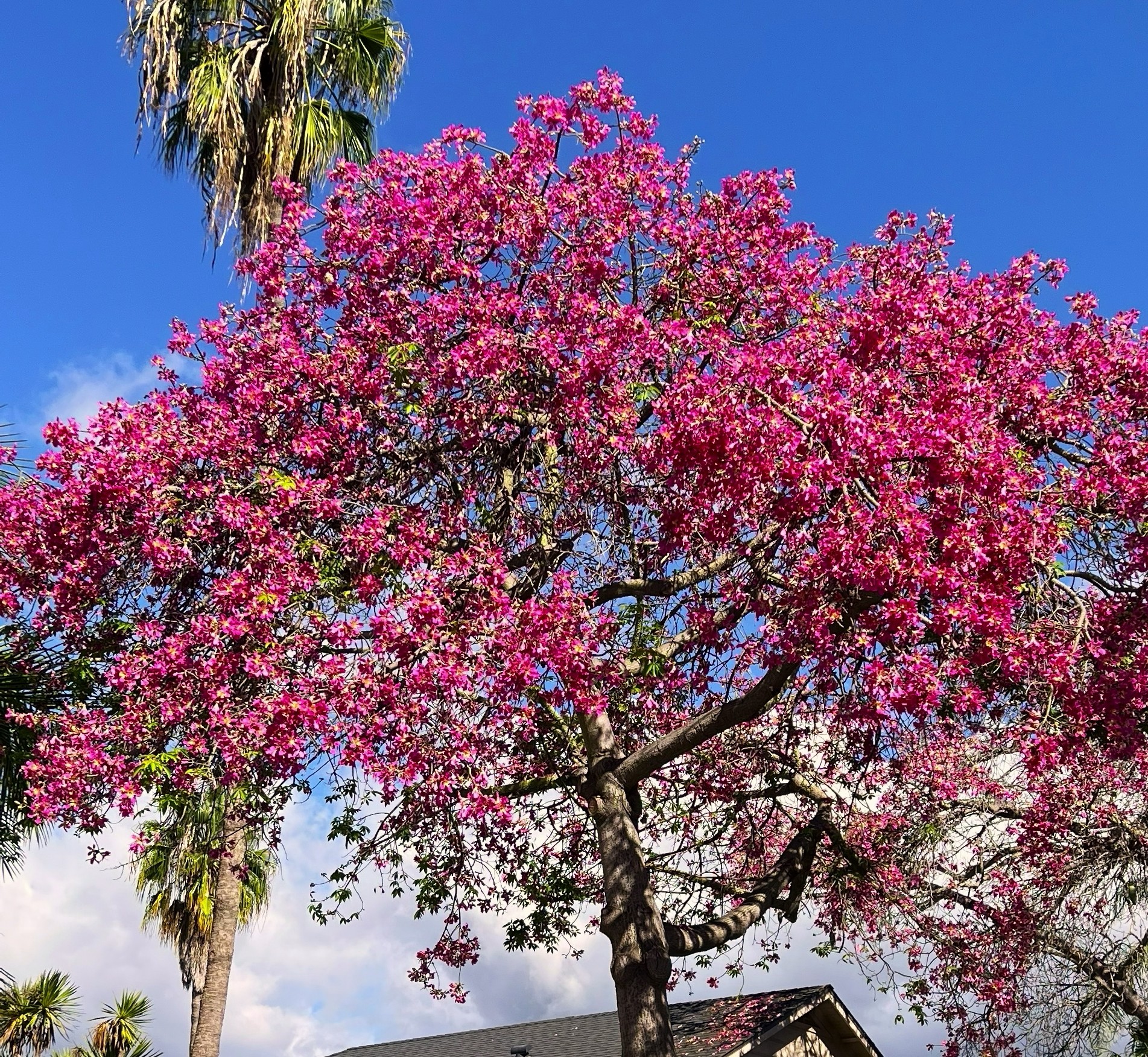
 The Silk Floss tree is perhaps the most astounding tree seen in Santa Barbara. Remarkably, it blooms in the fall. Exotic-looking, it is covered with intensely colored blossoms, bears large seed pods, and has a trunk covered with oversized thorns.
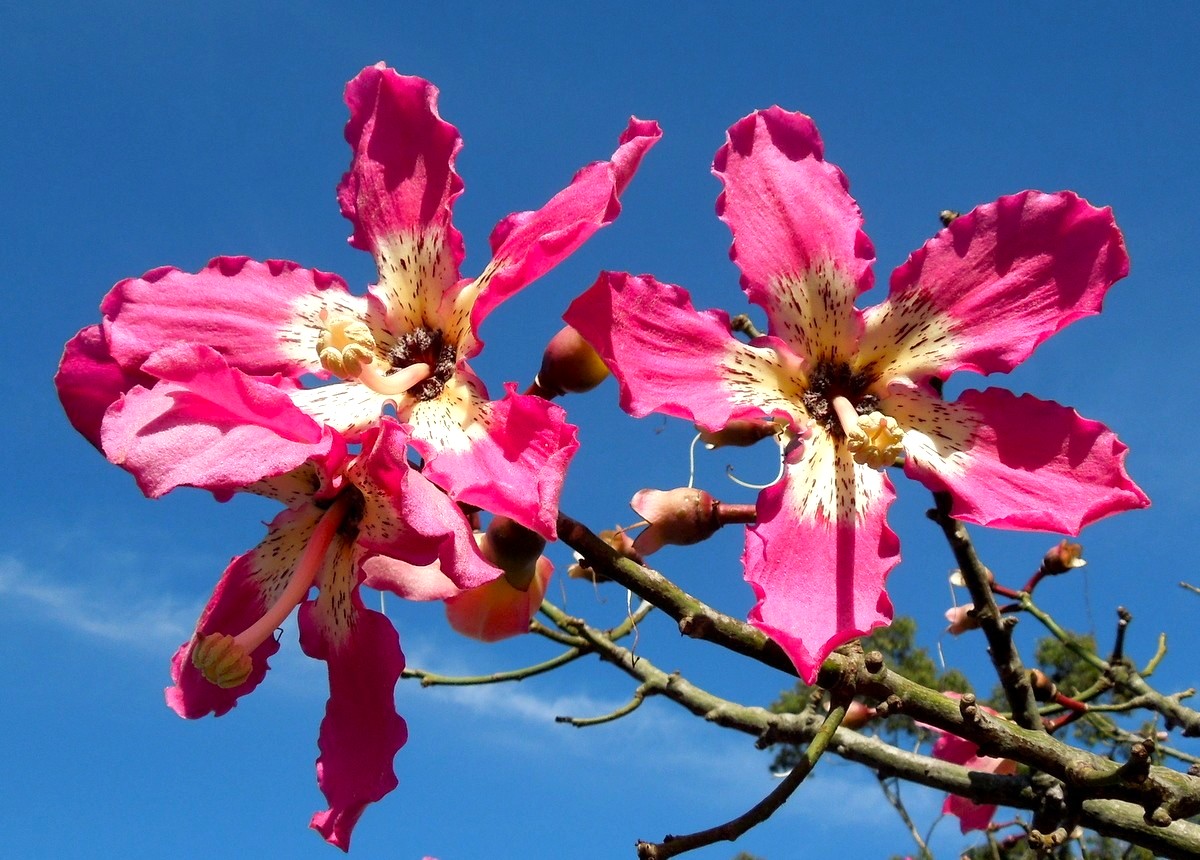 The fabulous blossoms are so big, so vibrant, and so prolific, that they instantly catch your attention, even from a distance. The blooms are either pink-and-white, pink-purple, or all-white, depending on the species or cultivar. They resemble oversized hibiscus flowers (understandably so, as the two plants are in the same plant family). Individual flowers can be over 4-inches across. They have five petals, each of which is white to yellow at the base and adorned with brown stripes or spots. The blooms are classified as “perfect”, meaning each has both male stamens and a female pistil. They are pollinated by bees and hummingbirds, which eagerly lap up the sweet nectar.
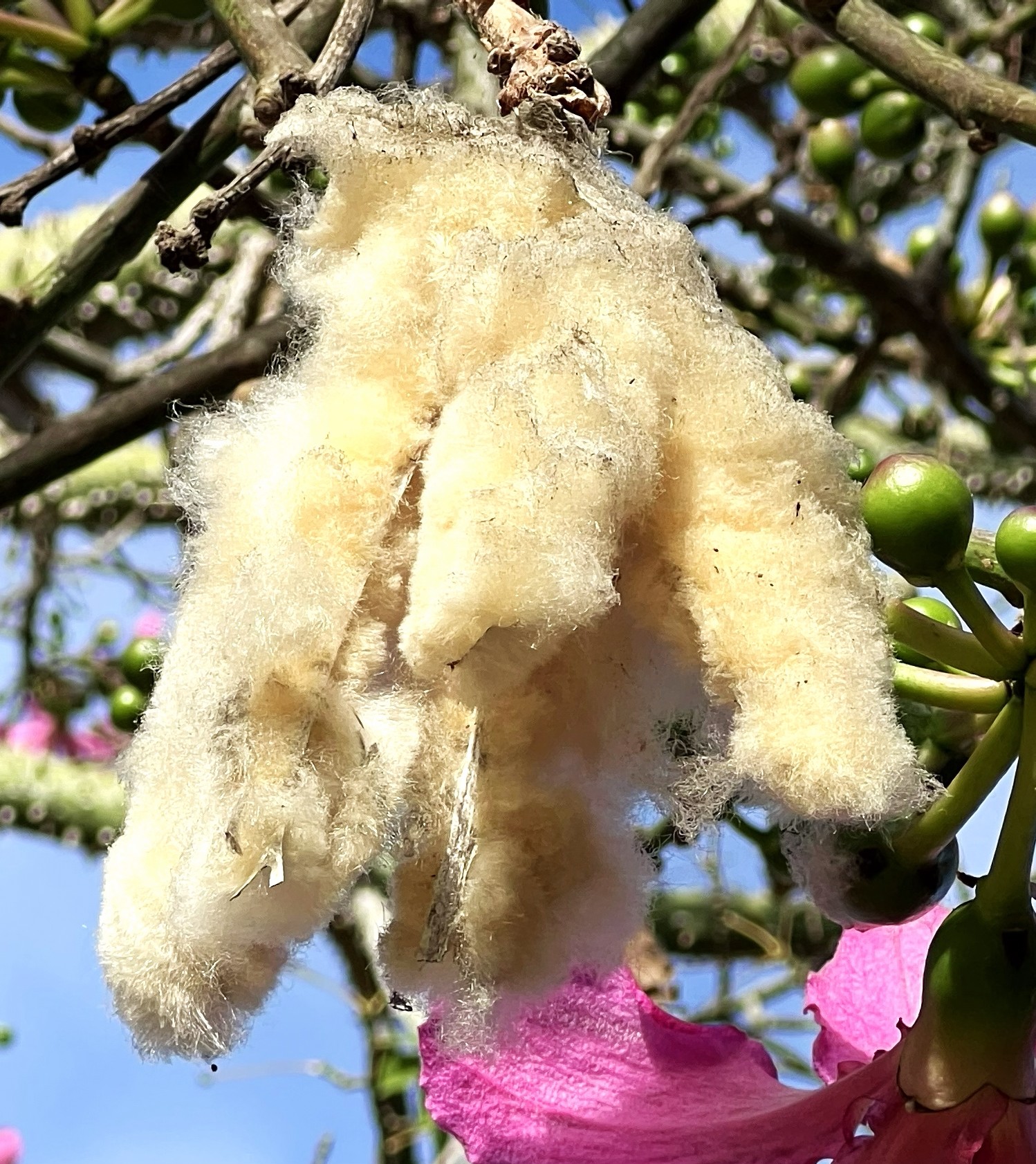
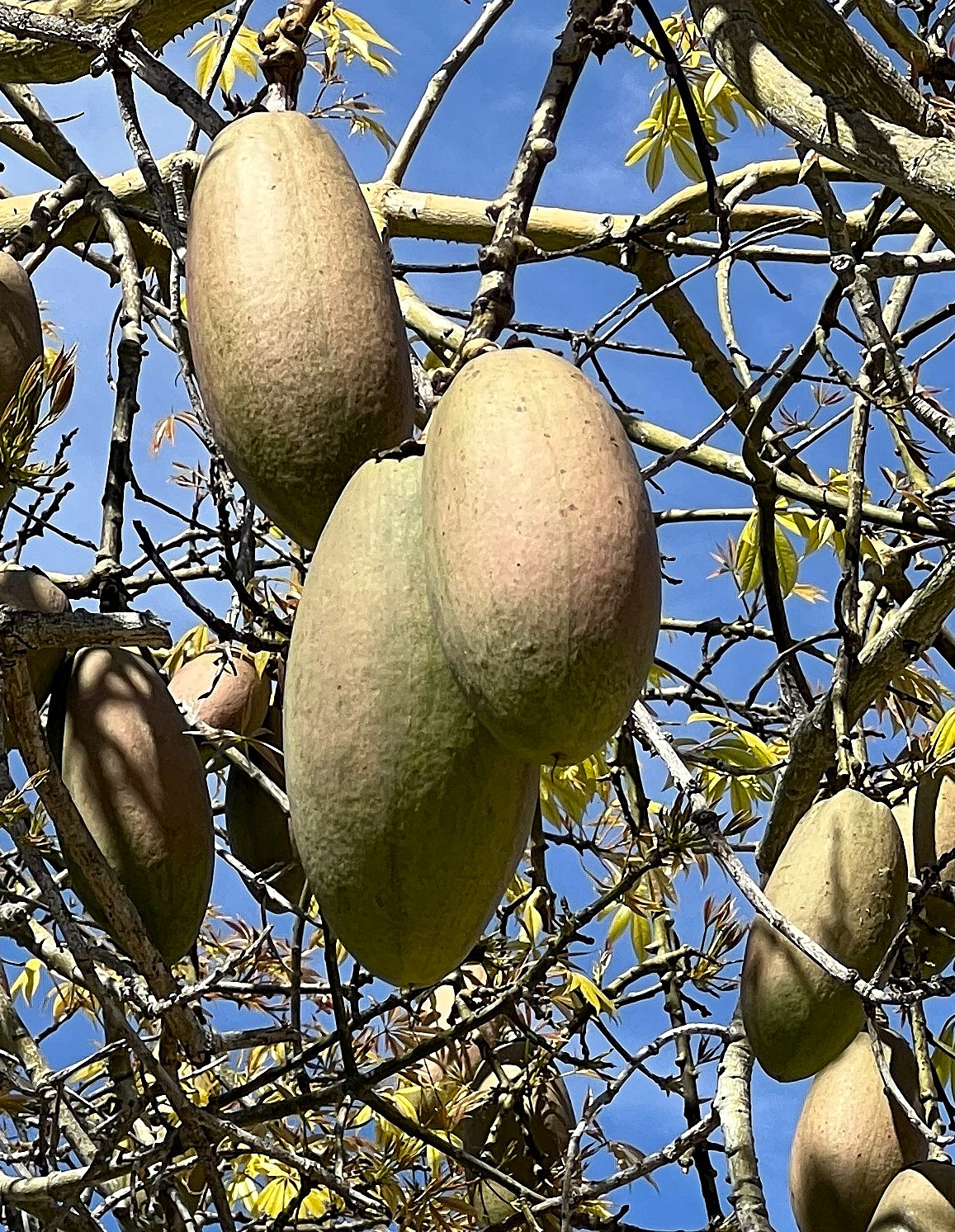 After pollination, the blooms develop plump seed pods that look like enormous dangling sausages with smooth green skin. When ripe, they turn dark brown, dry and crack open to expose black seeds covered white cotton-like stuffing – which is the reason for the common name “Silk Floss Tree”. Gobs of these soft fluffy fibers easily blow off in the breeze, like drifts of cotton candy, carrying with them the little black seeds for dispersal.
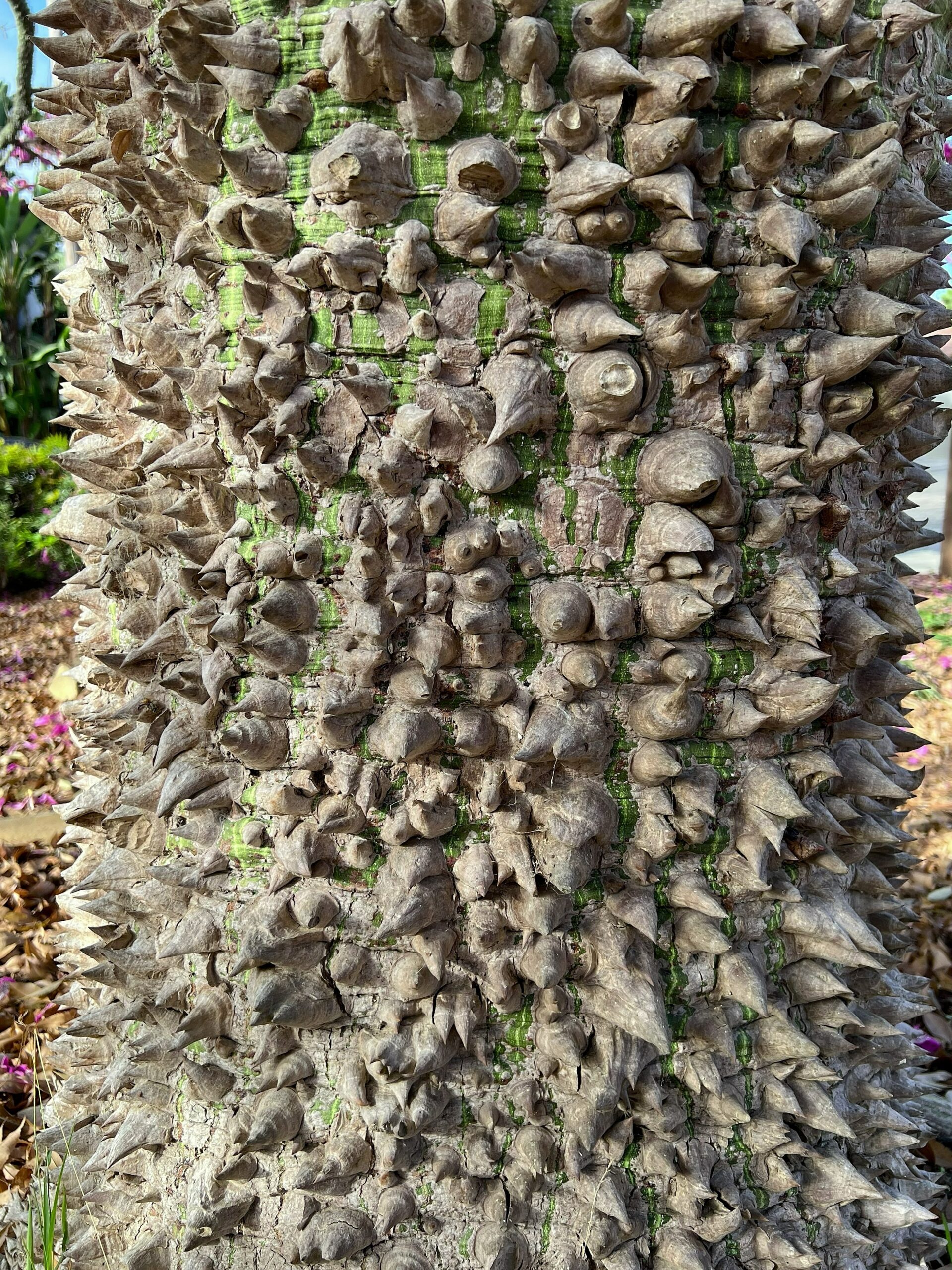
 The trunk is truly curious, because it is naturally studded with very large – very numerous – and very sharp – conical thorns. The thorns very effectively protect the trunk. Fortunately, if you want a tree without these formidable thorns, there are grafted varieties available that have eliminated them, leaving a smooth trunk with light-green bark.
 It is a relatively fast-growing tree and can become quite large at maturity. In ideal growing conditions, it can reach 50 feet in height with a 40-foot spread. However, most standing in our community remain much smaller. The round crown can be dense or open and is often asymmetrical. The distinctively light green to lime-green leaves (4-to 8-inches across) are palmately compound and carry 5 to 7 leaflets (2- to 4-inches long and ½- to 1½-inches wide).
It does best in deep sandy loam soils, but it can be grown in most areas of our City. It should be planted in full sun and given adequate space to accommodate its large surface roots. It requires only an occasional deep watering; an established tree is quite drought tolerant. It will drop its leaves if the temperature drops below 27° F, though it will re-foliate when the weather warms.
The Silk Floss Tree is native to the tropical rain forests of Brazil and Argentina. It was introduced into California in 1900 by the Santa Barbara pioneering horticulturist and nurseryman Dr. Francisco Franceschi.
It is in the Malvaceae plant family. Its usual common name is “Silk Floss Tree”, though it is also called “Floss Silk Tree”. Its botanical name is Ceiba speciosa. The genus name, Ceiba, is the Latinized version of the South American name for the Floss Silk Tree. The specific epithet, speciosa, also comes from Latin, and means “showy” or “brilliant”, referring to the flowers.
Its happy combination of strikingly beautiful flowers, drought tolerance, and low maintenance requirements have made Silk Floss Tree an increasingly popular choice for planting in our parks, on our streets, in residential gardens, and in commercial landscapes.
Mature Silk Floss Trees are street trees in the 2400 block of Santa Barbara Street, the 200 block of West Yanonali Street, and the 200 block of South Voluntario Street. A fine pink one stands at a residence in the 200 block of Alameda Padre Serra. Both the pink-flowering and the white-flowering species can be seen next to the west fence (on the Santa Barbara Street side) of Alice Keck Park Memorial Garden – a tall pink one stands alongside the Cypress Allee in Ganna Walska Lotusland – and a white-flowering species, Ceiba insignis, is in the parking lot of the Santa Barbara Zoo.
Tree-of-the-Month articles are sponsored by Santa Barbara Beautiful, whose missions include the increase of public awareness and appreciation of Santa Barbara’s many outstanding trees and, in a long-time partnership with the City Parks & Recreation Department, the funding and planting of trees along the City’s streets.
Those who wish to honor a special someone can do so with an attractive commemorative marker that will be installed at the base of an existing street tree in the City of Santa Barbara. Because Santa Barbara Beautiful has participated in the planting to date of over 14,000 street trees, there are plenty of trees from which to choose! Application forms are available on the Santa Barbara Beautiful website, www.sbbeautiful.org. This website also contains an archive of all previously published Tree-of-the-Month articles, including photos.
Article and Photos by David Gress