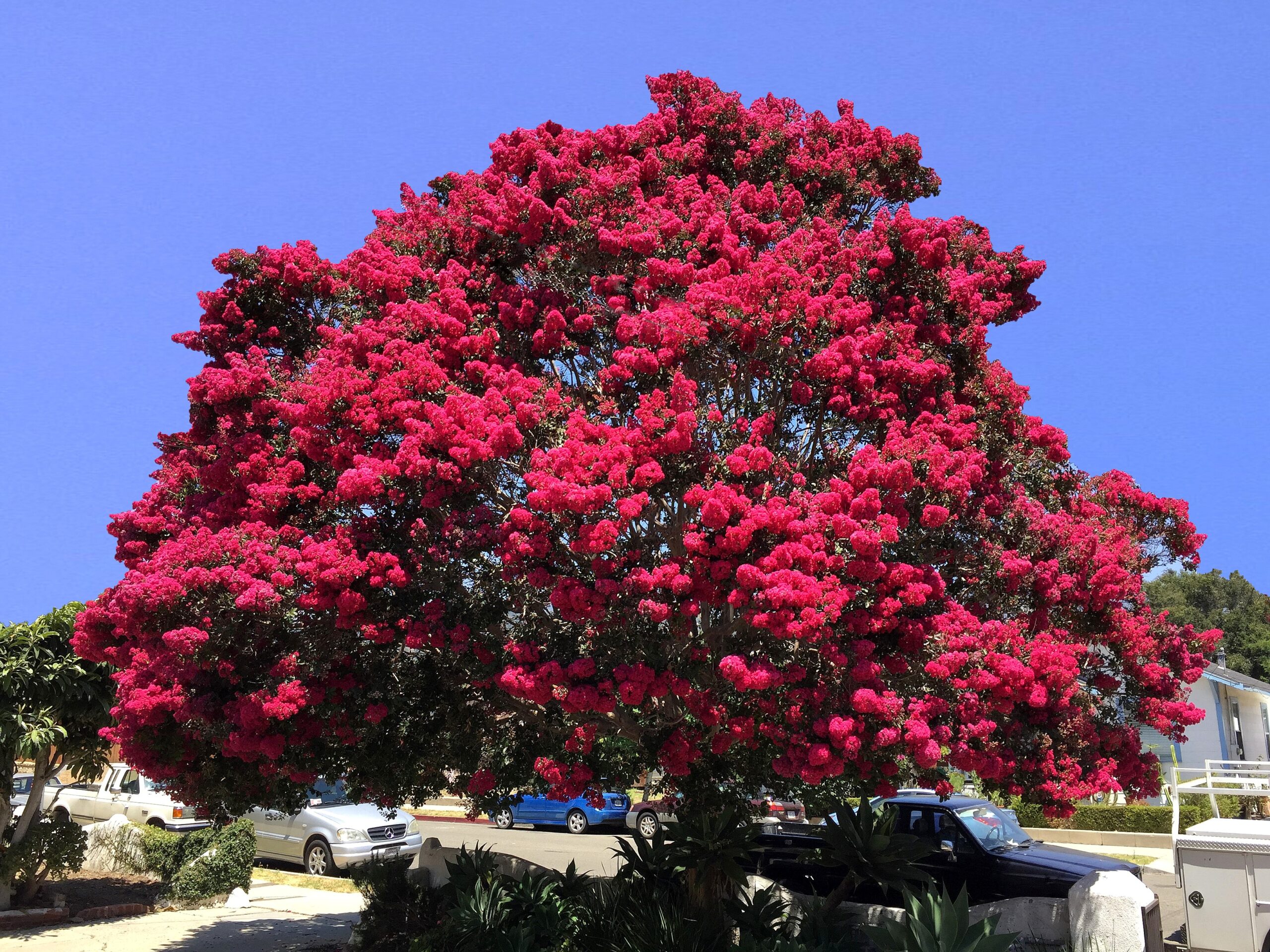
 In late summer through early fall in Santa Barbara, the brilliantly colored floral displays of Crape Myrtle trees are spectacular standouts in the landscape – one of the longest lasting floral displays of any tree or shrub.
Crape Myrtle is a deciduous small- to medium-sized tree that grows 15- to 30-feet tall with a canopy spread of 15- to 20-feet. It grows naturally as either a shrub or a tree, often with multi-stemmed trunks, but can be trained into a single-trunked tree.
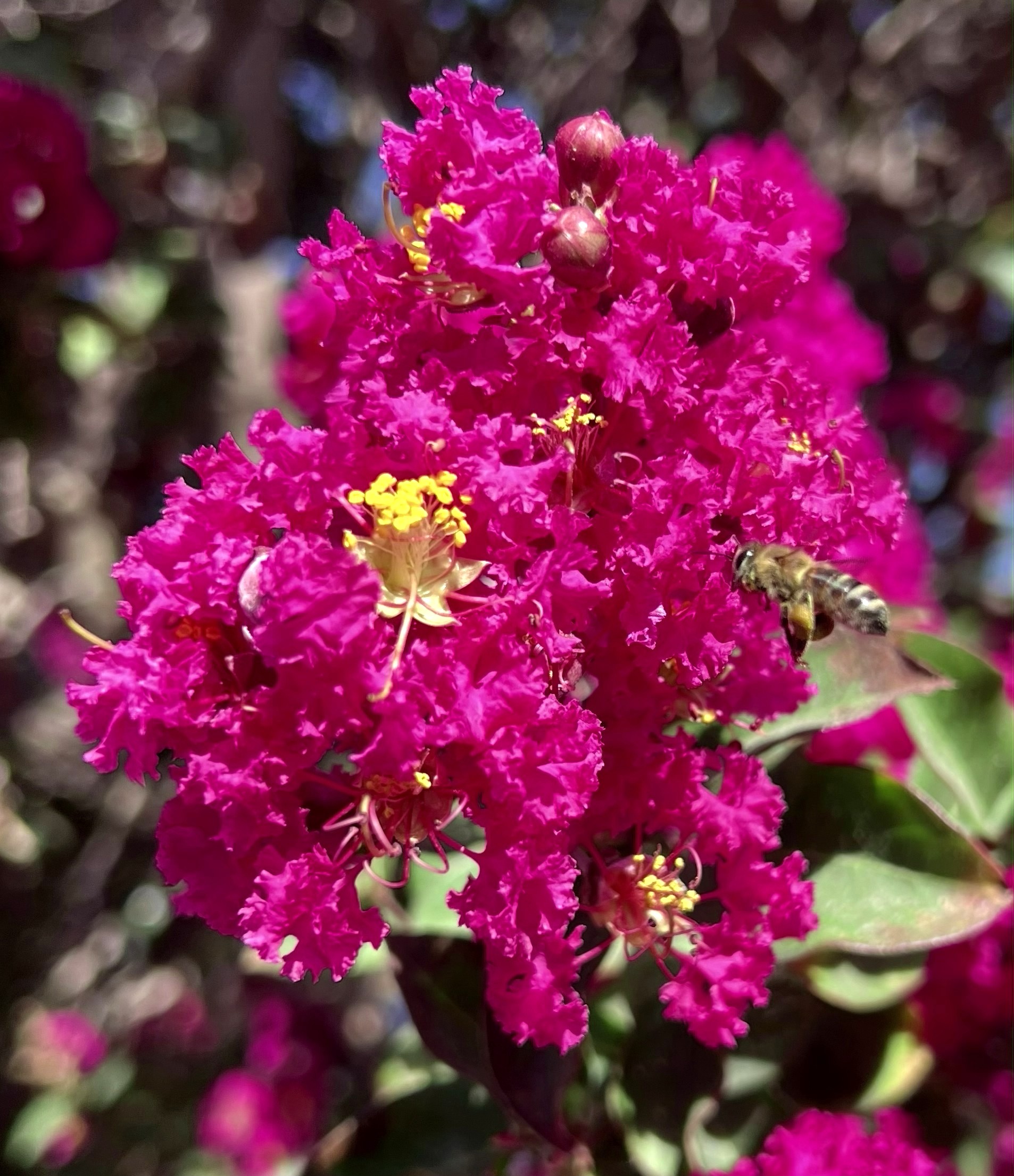
The flower petals resemble crinkled crepe-paper – the basis of this tree’s common names of “Crape Myrtle” and “Crepe Flower”. Individual flowers are only about one inch across, but the great masses of them that appear on all the boughs provide a dramatic show. Long flower clusters (6- to 18-inches in length), called “panicles”, appear at the ends of new shoots. Many varieties are now commercially available, with flower colors ranging from white, pink, vibrant red, lavender, to purple. The flowers are classified as “perfect”, meaning each bloom has both male stamens and a female pistil. The flowers are pollinated by bees, which eagerly lap up the copious nectar.
 The glossy, dark green, oval leaves (2- to 4-inches in length) provide stunning fall colors, turning into various shades of red, yellow and orange.
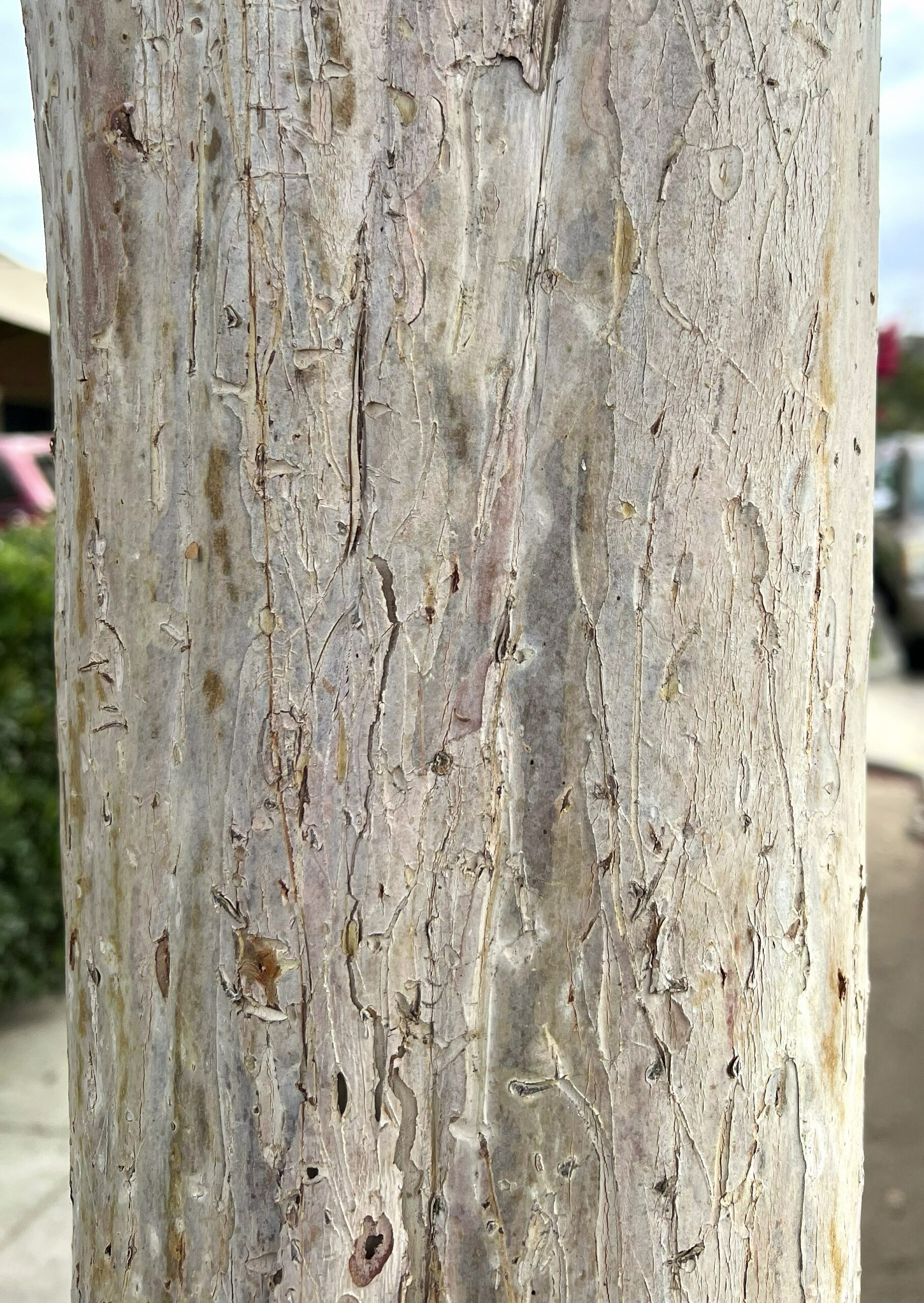
The attractive bark is smooth – displaying a mottled pattern of tan, gray, brown, cinnamon and soft pink that can be enjoyed all year long, especially in winter when the tree is leafless.
 Crape Myrtle is native to subtropical Asia from India to Japan. It was introduced into European horticulture in 1759 and is now grown worldwide in all mild climate areas. It is in the plant family Lythraceae. The botanical name is Lagerstroemia indica; the genus name honors the Swedish merchant Magnus von Lagerstrom and the specific epithet means “India”.
Crape Myrtle is a good choice for the Santa Barbara area, because it is generally drought-resistant and able to grow quite nicely with only our average yearly rainfall. Of course, it will need supplemental irrigation to become established and during times of below average rainfall or during extended drought. It will tolerate all types of soil, provided it is well-drained. It is best to plant it in hotter locations that get full sun; the amount of flowering is directly related to the amount of sunshine received. Hotter locations also reduce the chance for the development of powdery mildew on the foliage.
Warmer weather in recent years, along with the development of hybrid varieties (like crossing L. indica and L. fauriei), have made Crape Myrtle an even more desirable choice for planting locally. At least 15 hybrid varieties are now available. These improved mildew-resistant trees are named after Native American tribes and include the popular varieties “Tuscarora”, “Arapaho”, and “Natchez”.
This easy-to-grow tree will reward you with a delightful display of flowers, leaves, and bark all year round. Its happy combination of striking flowers, drought tolerance, and low maintenance requirements have made it an increasingly popular choice for planting on our streets, in residential gardens, and in commercial landscapes.
Mature Crape Myrtles can be seen as street trees all around Santa Barbara: in the 400 block of San Roque Road; in the 300 block of West Alamar; and, in the 700 and 800 blocks of West Carrillo Street. A large one stands at the County Administration Building parking lot entrance on the 100 Block of E. Victoria Street. There is a magnificent specimen on private property in the 700 block of Olive Street. Younger street trees have been planted, too: along the 700 and 800 blocks of East Canon Perdido Street; in the first block of West Calle Crespis; and, in the 1000 and 1100 blocks of East Gutierrez Street.
Tree-of-the-Month articles are sponsored by Santa Barbara Beautiful, whose missions include the increase of public awareness and appreciation of Santa Barbara’s many outstanding trees and, in a long-time partnership with the City Parks & Recreation Department, the funding and planting of trees along the City’s streets.
Those who wish to honor a special someone can do so with an attractive commemorative marker that will be installed at the base of an existing street tree in the City of Santa Barbara. Because Santa Barbara Beautiful has participated in the planting to date of over 14,000 street trees, there are plenty of trees from which to choose! Application forms are available on the Santa Barbara Beautiful website, www.sbbeautiful.org. This website also contains an archive of all previously published Tree-of-the-Month articles, including photos.
Article and Photos by David Gress