
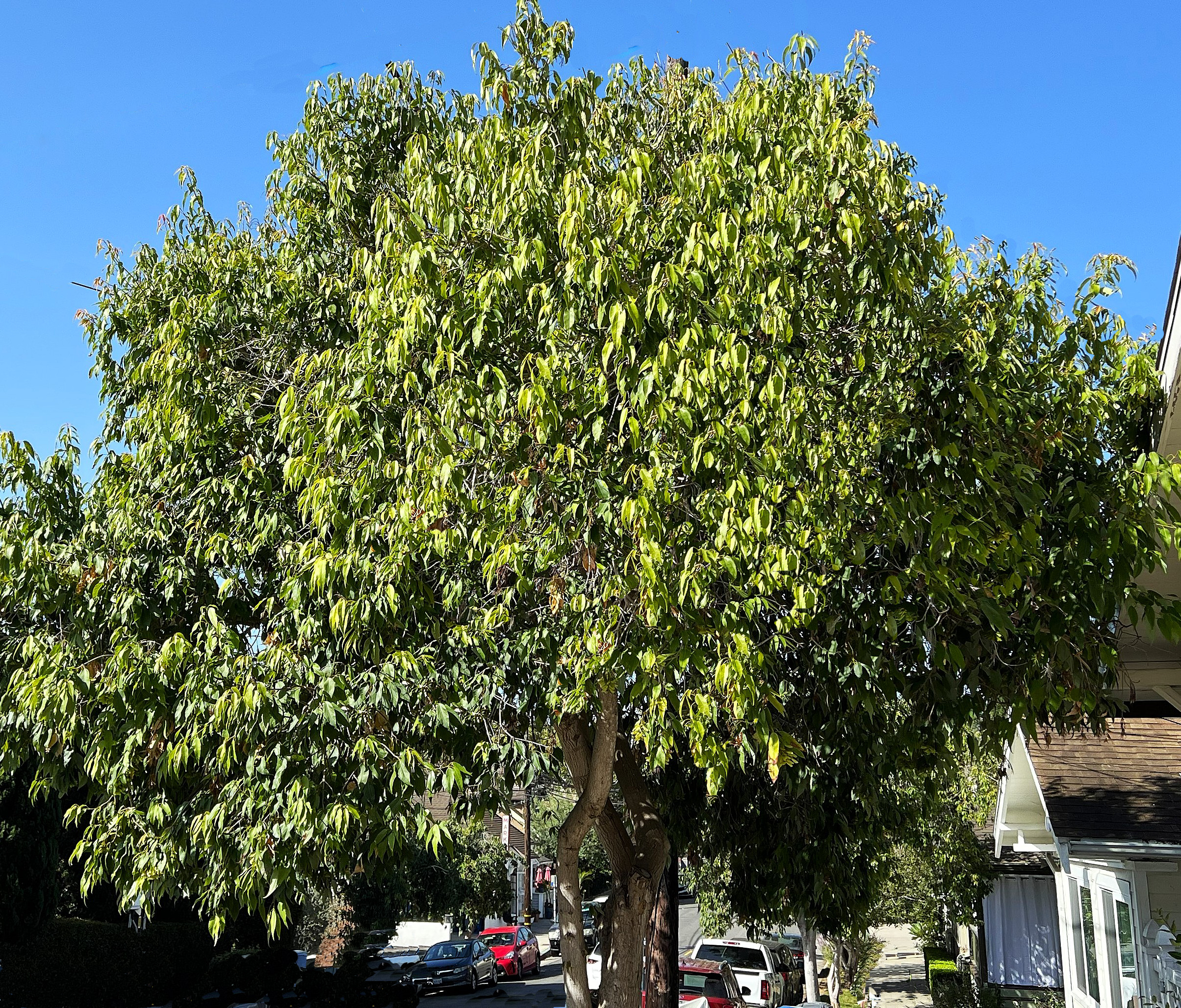
 Himalayan Maple is a rather odd maple tree – one that fails to have nearly every aspect usually associated with maples. It is not deciduous – its leaves neither change color nor fall off in autumn; rather, it is evergreen the year round. Moreover, its leaves are neither lobed nor indented – like the stylized maple leaf on the Canadian Flag; instead, they are lance-shaped and bear smooth margins that may be slightly scalloped.
The only thing “maple-ish” about it are its seeds, which are the traditional winged samaras.
As its name implies, Himalayan Maple is native to the lower humid Himalayan regions of Nepal, Kashmir (now named Bhutan), western China, and northern India, at elevations of 2,000 to 6,500 feet. It was first imported into Great Britian 1824 – and was introduced into Santa Barbara in the early 1900s by Dr. Francesco Franceschi, one of our pioneering local horticulturists.
Himalayan Maple is a small- to medium-sized tree that can reach a height of 25-feet (though it often remains shorter), is rather slow-growing, and carries a dense oval-shaped crown.
The most notable feature is its thick, graceful, and glossy foliage. Its leaves are long (5-inches in length; 2½- inches in width), leathery, dark green on the top side and pale whitish green on the underside. New growth can be an attractive reddish bronze color.
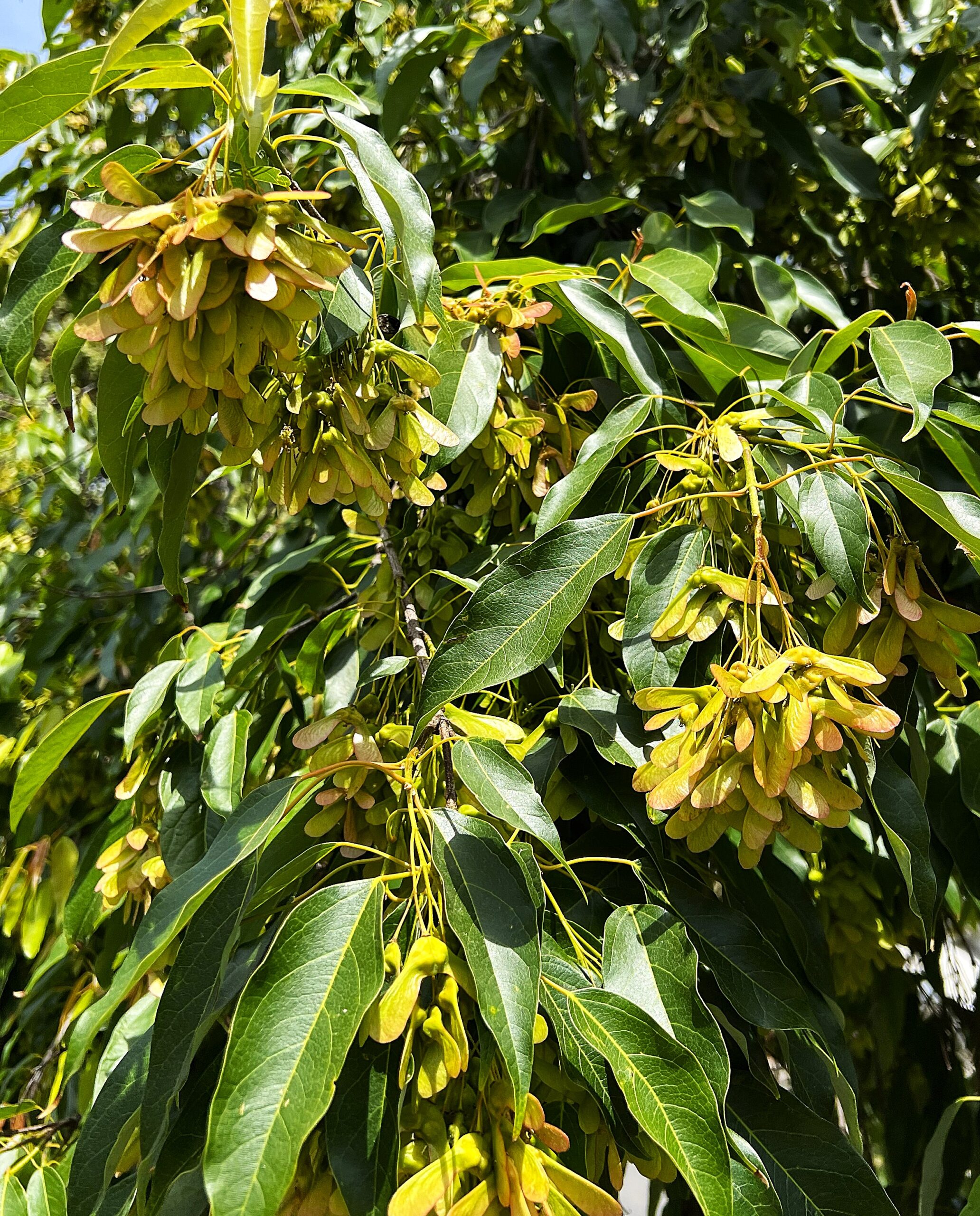
The light gray bark makes a striking contrast against the vibrant foliage. When the tree is young, its bark is smooth; with age, it develops cracks and irregular plates that peel off.
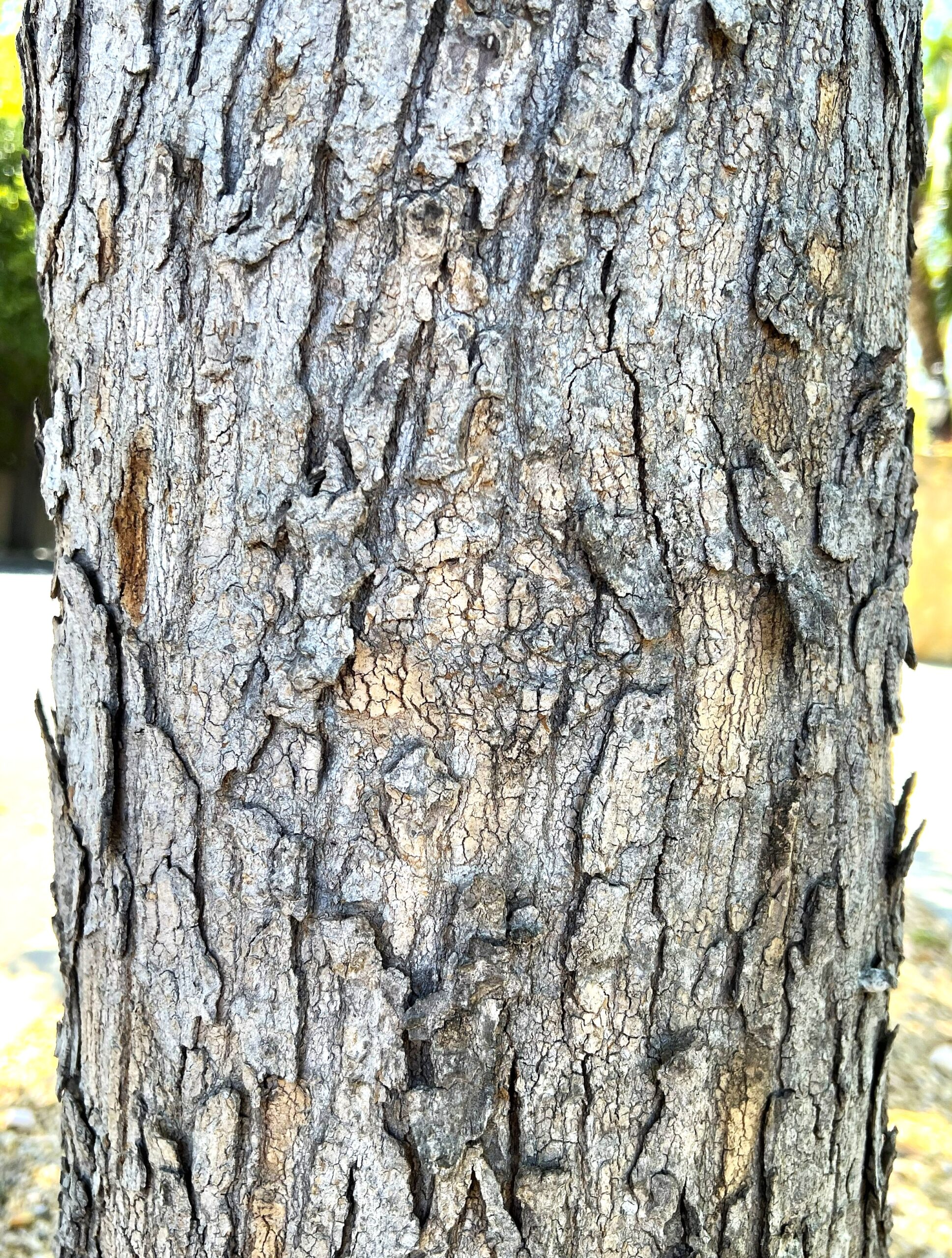 In December and January, clusters of small, inconspicuous, yellow-green flowers appear among the leaves. The flowers are “perfect”, which means each flower contains both male and female sexual parts; these can cross-pollinate with another tree or self-pollinate, greatly aiding reproduction. Pollinated flowers produce hard seeds with paper-like wings (1-inch long), called samaras, which will spin off in crazy circles when the wind blows. The seeds occur in large bunches near the ends of branches – and can persist on the tree for more than one season.
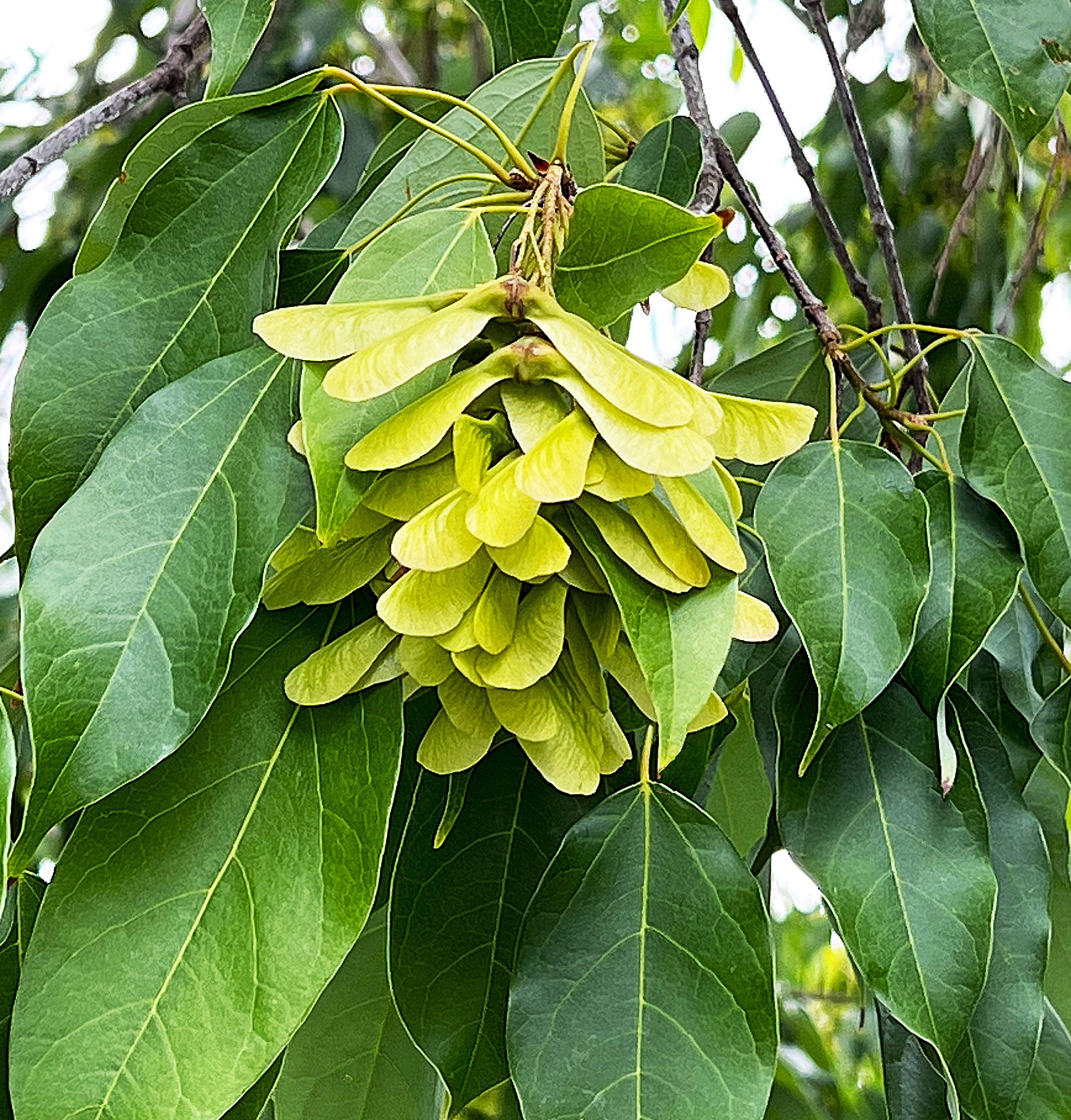
Other common names for the Himalayan Maple are “Kashmir Maple”, “Oblong Maple”, and “Flying Moth Tree”. As with all the species of maples, it has recently been reclassified into the Sapindaceae (Soapberry) plant family, though its botanical name remains Acer oblongum. The genus name, Acer, is the Latin word for “maples”. The specific epithet, oblongum, is also Latin and means “oblong”, referring to the long and narrow leaves.
Himalayan Maple is one of two evergreen maples that are grown in our area. The other is appropriately named “Evergreen Maple”, the botanical name of which is Acer paxii (the name honors F. Pax (1858-1942), a taxonomist of maples). It grows to be a little larger (up to 40-feet) than the Himalayan Maple – and has three-lobed leaves that are more similar in shape to those of common deciduous maples. It is native to the mountain forests of southwestern China.
Himalayan Maple prefers full sun – but can tolerate partial shade. It can grow in many soil types – but prefers a deep sandy loam. It can survive with our normal rainfall – but generally needs an occasional deep watering during the dry season and especially during periods of extended drought. It is cold hardy to 20⁰ F. It is surprisingly easy to propagate from seeds – when started in a moist planting mix, germination occurs within a few weeks.
In our community, Himalayan Maple is grown primarily as an ornamental tree, due to its attractive evergreen foliage and small size. It is useful in private gardens and in parks and serves as a fine street tree.
Himalayan Maples (Acer oblongum) are seen as street trees in the 300 to 500 blocks of East Micheltorena Street, on the northeast corner of Vista de la Cumbre and Calle Rosales, and in the 2000 block of Santa Barbara Street. Evergreen Maples (Acer paxii) are seen as street trees in the 2200 block of Santa Barbara Street.
Tree-of-the-Month articles are sponsored by Santa Barbara Beautiful, whose many missions include the increase of public awareness and appreciation of Santa Barbara’s many outstanding trees and, in a long-time partnership with the City Parks & Recreation Department, the funding and planting of trees along the City’s streets.
Article and Photos by David Gress