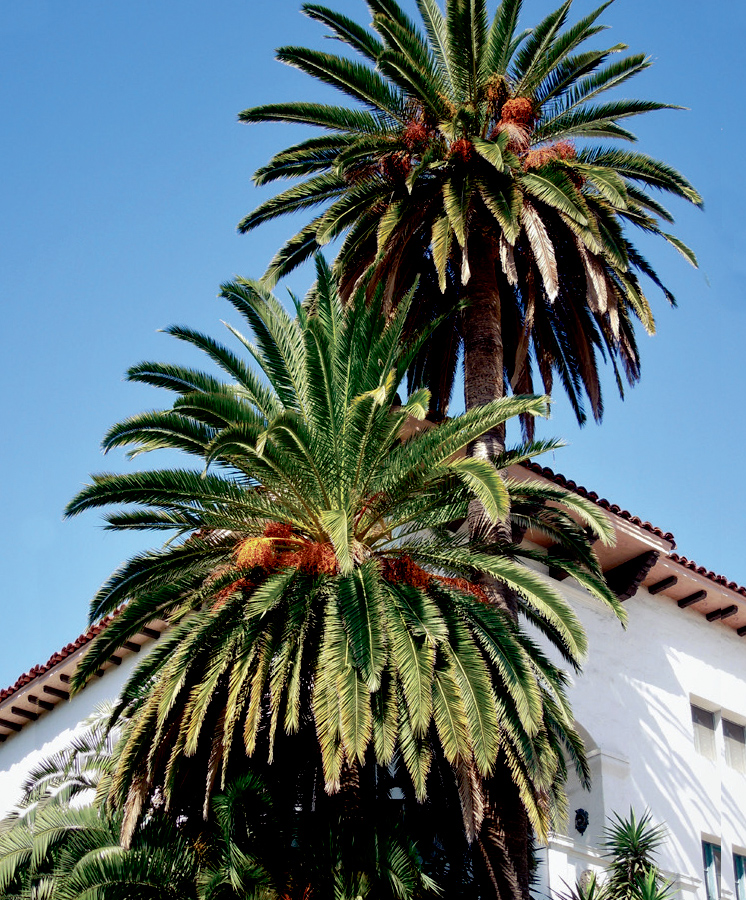
 Canary Island Date Palms have a stately presence that dominates any landscape. They certainly give Santa Barbara the look and feel of a Mediterranean resort.
This is truly a massive palm – growing to over 75-feet in height on a stout trunk up to 3-feet in diameter. Its dense crown, which looks like the enormous round ball of an exploding firework, can have over 200 living fronds. Each frond is feather-like (pinnate), deep green, gracefully-arching, and 15- to 20-feet in length. Massive and magnificent!
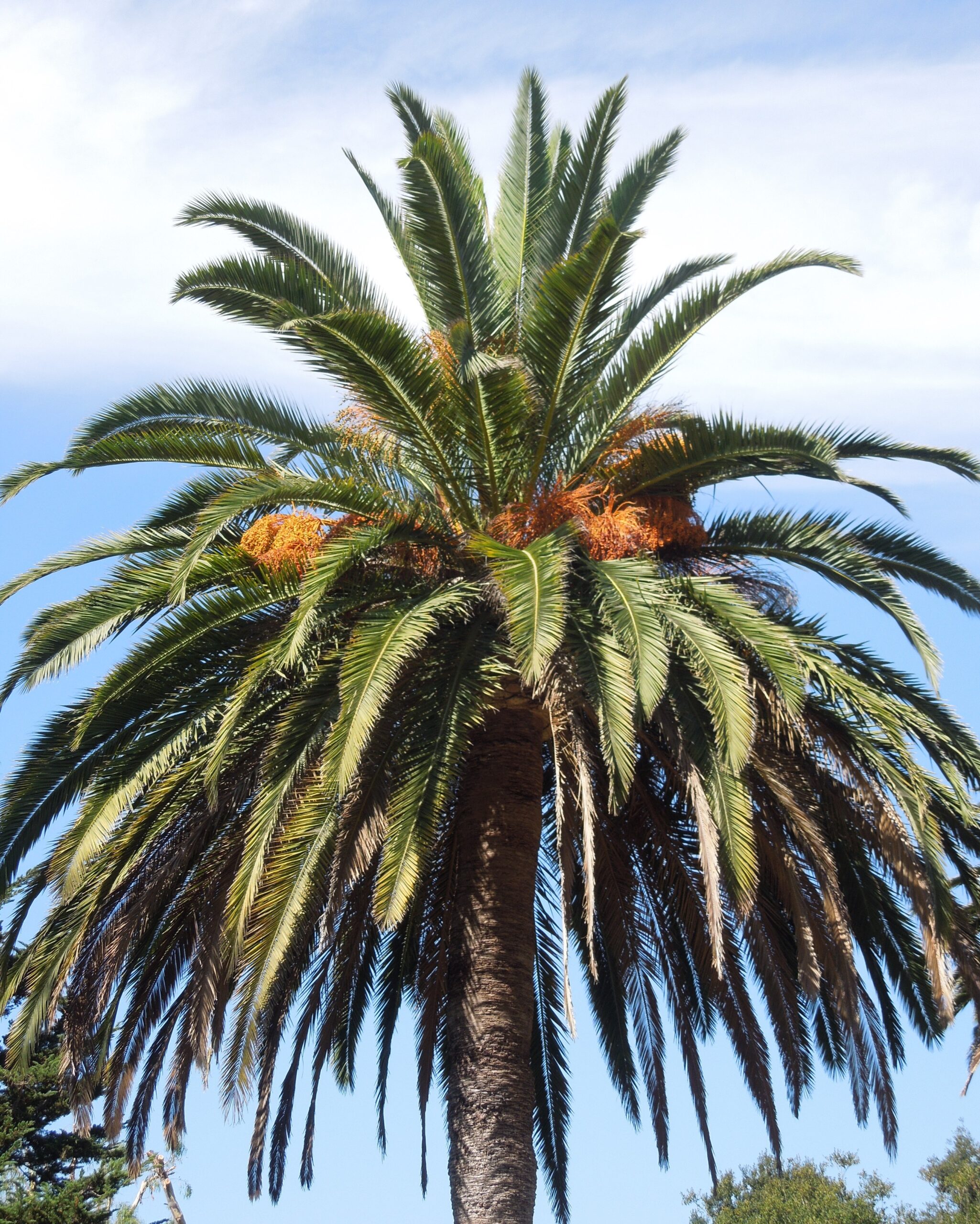 From December through April, multiple flower-bearing structures, called inflorescences, will develop from between the fronds. The inflorescences are each 4- to 6-feet long and are conspicuously bright orange. On them will appear clusters of bright orange flowers. The bright orange stands out dramatically against the green fronds.
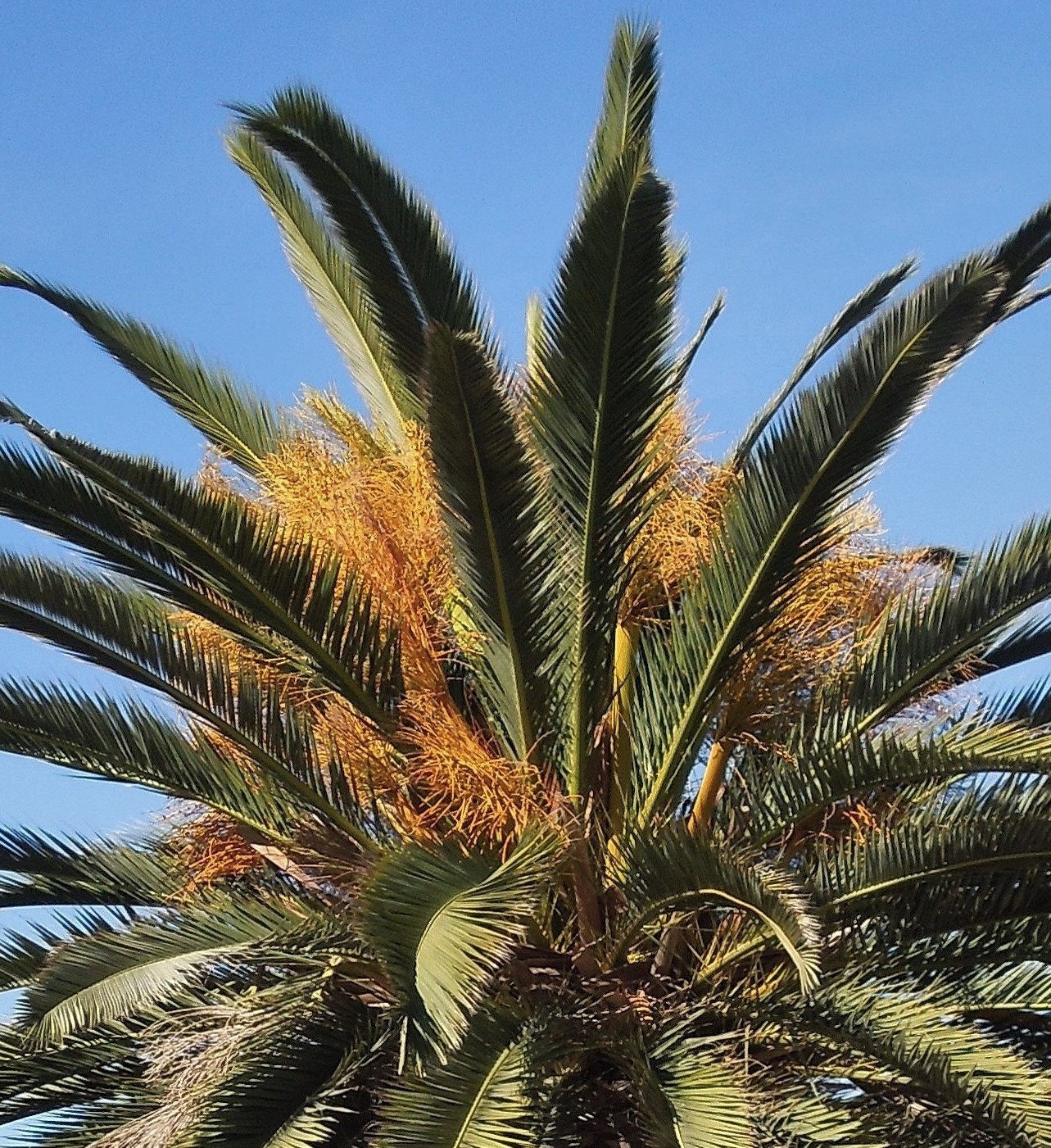 All date palms are “dioecious”, meaning that male flowers and female flowers occur on separate trees. In summer and fall, pollinated female flowers will ripen into large clusters of 1-inch long, ovoid, bright yellow-orange fruits. Each fruit contains a single large seed.
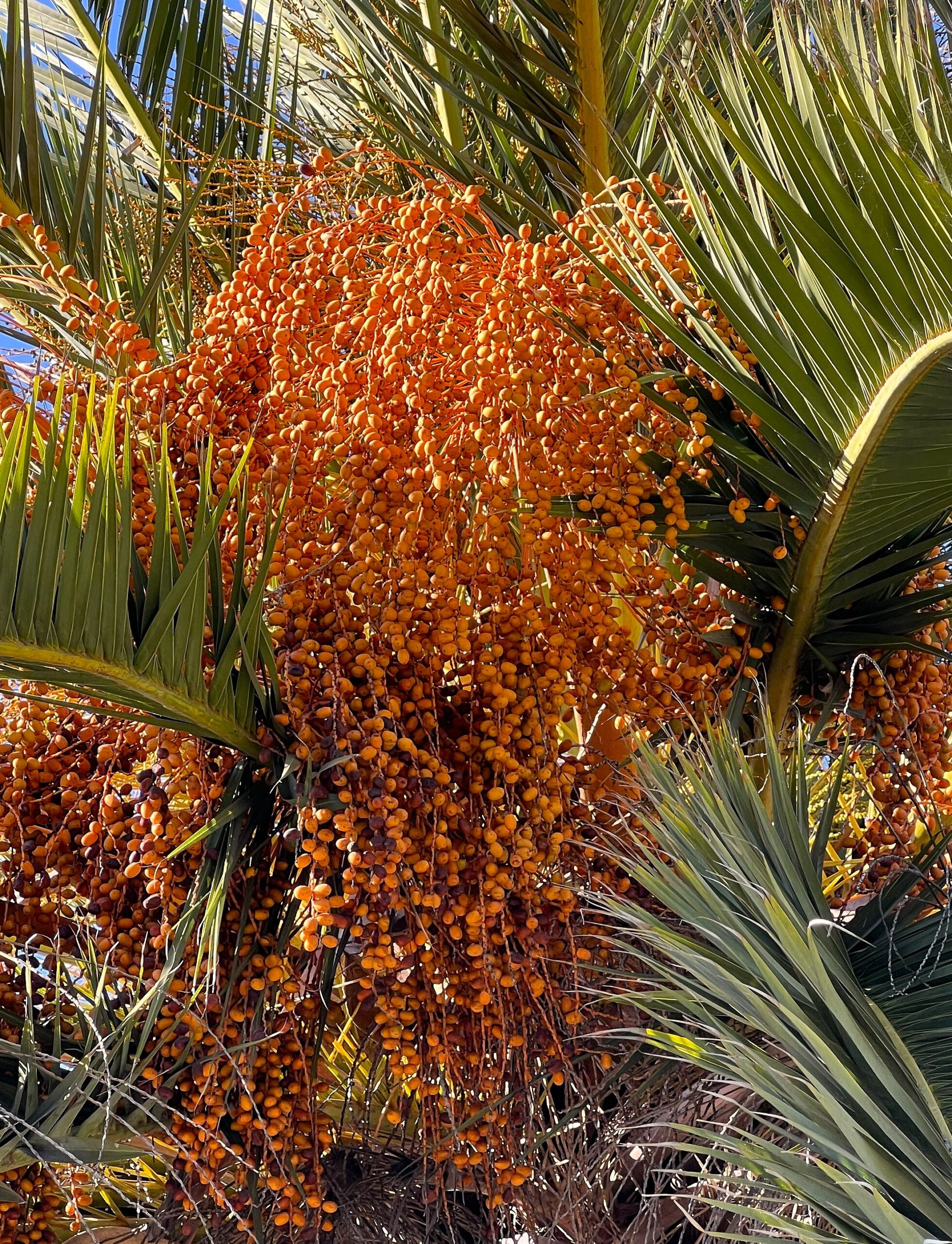 Canary Island Date Palm fruits are not like common dates, such as tasty Medjool dates, which have been cultivated (and eaten) by humans for over 8,000 years and which you can buy at most grocery stores or farmers’ markets. Medjool dates are produced on the species Phoenix dactilifera, a close palm relative of the Canary Island Date Palm.
Nevertheless, Canary Island Date Palm fruits are enjoyed and eaten by wildlife. The seeds are then widely disbursed by birds and rodents, far from the parent palm, so they are often found growing in places where they were not intentionally planted!
As its common name implies, this palm is native to the Canary Islands, which are in the Atlantic Ocean (off the coast of northwestern Africa) and which are owned by Spain. These islands enjoy a Mediterranean climate very similar to our own.
Consequently, though imported, the Canary Island Date Palms have done very well in the Santa Barbara community. Their seeds may have been brought here by the mission padres during our Spanish colonial period starting in the 1780s – the fronds were used during Palm Sunday rituals. In the mid-1800s, pioneering local horticulturists in our area started to plant them all around town as landscape specimens.
Easily propagated from seed, Canary Island Date Palm grows slowly as it develops its sturdy trunk – and then it grows upward much faster. When mature, it is very drought tolerant. When young, it will look and grow better with occasional deep watering in the dry season.
In the late winter or spring, if the fronds become light-green or yellow, do apply a fertilizer formulated specifically for palms – one that contains the necessary micronutrients of manganese and magnesium. Older fronds will turn brown with age and persist (hang against the trunk). Many landscapers will prune these off – leaving a large ball of brown frond bases at the top of the trunk, just below the newer fronds; the ball will have a pineapple-fruit-like appearance. Beware when pruning: the frond stems have sharp spines that require great care to avoid personal injury!
Fortunately, this regal palm is tolerant of most soils, even the poor types often found in our area.
Unfortunately, it is susceptible to an incurable fungal disease, “Fusarium wilt”, which can be transmitted either through contaminated soil or through pruning tools previously used on a diseased palm and left uncleaned. The spread of this fatal disease can be greatly reduced if safe pruning protocols are followed – by properly disinfecting all tools before using them on another palm.
It is also susceptible to infestations of two species of nasty bugs, the South American palm weevil and the Asian palm weevil (a.k.a. red palm weevil). These pests will burrow into the trunk and crown, destroying the heart of the palm, causing fronds to drop, and weakening structural integrity – frequently killing the palm.
In addition to its common name of “Canary Island Date Palm”, it also has the common name “Pineapple Palm” – referring to the ball shape formed when the older lower fronds are overly pruned. Its botanical name is Phoenix canariensis. The genus name, Phoenix, comes from the Greek and simply means “date palm”; the specific epithet, canariensis, refers to its home islands.
The Canary Island Date Palm is most impressive when planted in long formal rows. It can also be planted in groups of three or more for dramatic effect. It may be a bit too big for smaller residential yards – but is perfectly suited for larger properties and for public spaces, such as parks, boulevards, and commercial developments.
There are many mature specimens in town, most of which are over 100 years old now. They can be seen in East and West Alameda Park, in Alice Keck Park Memorial Garden, at the County Courthouse, in Chase Palm Park, in front of the Main House in Ganna Walska Lotusland – and, in double rows, along Las Palmas Drive in Hope Ranch and along the margins of Ambassador Park in the 100 Block of West Cabrillo Boulevard (the original entrance to the long-gone Potter Hotel). Many smaller examples can be seen throughout town; they seem to pop up everywhere, whether planted or not!
Tree-of-the-Month articles are sponsored by Santa Barbara Beautiful, whose missions include the increase of public awareness and appreciation of Santa Barbara’s many outstanding trees and, in a long-time partnership with the City Parks & Recreation Department, the funding and planting of trees along the City’s streets.
Those who wish to honor a special someone can do so with an attractive commemorative marker that will be installed at the base of an existing street tree in the City of Santa Barbara. Because Santa Barbara Beautiful has participated in the planting to date of over 14,000 street trees, there are plenty of trees from which to choose! Application forms are available on the Santa Barbara Beautiful website, www.sbbeautiful.org. This website also contains an archive of all previously published Tree-of-the-Month articles, including photos.
Article and Photos by David Gress